A Hospital is Just a Collection of Small Practices Sharing Resources
Sure there is a hotel involved too, but why is it so eye-wateringly expensive? We discuss the reasons why and propose the only viable solution

Introduction
Normally, we talk about healthcare and health insurance in this space and today is no different. Today we are going to discuss why hospital care is so amazingly expensive, even making smaller and rural hospitals non-viable, and larger systems only continue to exist because they have the leverage to tell the big insurers what they are going to pay. This problem limits care choices, in some cases to zero, and increases cost. We will uncover why hospital care is so expensive and why and then we will show you how to stop the out of control spending.
The Situation
For the most part, hospitals and their administration just don’t care. If you aren't wealthy or have insurance you aren’t going to the hospital. Sure you can go to the emergency department, and they have to treat you, but that just exacerbates the problem making the service more expensive for everyone.
Doctors are only interested in doing what they do, not playing accountants. Every hospital I have ever seen has no clue what anything costs, what the consequences of cost is to care or even know how much money they have made until they see how much is left over at the end of the month.
Finances matter. I’ll even state that the United States does not have a healthcare crisis, it has a healthcare finance crisis. If healthcare in the US weren’t twice (or more) as expensive as anywhere else, it would be held up as a model for all.
What exactly is a hospital, if not a collection of small practices that all share resources? Why is this not less expensive than the independent practice, because of economies of scale and not having staff and equipment standing around idle because they are utilized by several other departments?
Other practices are outpatient you say. Sustained. That is a good point. So to the collection of small practices, add a hotel. The cost of the hotel should probably be offset by savings from shared resources. I mean, Srikanth can go buy an old Ramada Inn, stick an extra “N” on the sign and sell you a room for under $100 per night. Is Srikanth smarter or harder working than the entirety of the medical profession? Sure, hospitals have to have specific construction and architecture, but so do facilities many other industries.
I’ll submit that there are two reasons that hospital care is so expensive:
- Nobody really cares about the costs; they are doctors and they can just charge the patient/insurance company more
- General bizdiocy: hospitals have to charge enough so that even while they are not minding their own store, they can still be profitable. Nothing is forcing them to change, so they won’t.
The Logical Conclusion
If things continue the way they are, healthcare finance could bankrupt this country.
If things continue the way they are, healthcare finance could entirely collapse as more and more people just opt out and take their chances instead of seeing over half a premium they can’t afford being wasted.
It is looking more and more likely that the government is going to step in and attempt to run the entire industry and that will be an unmitigated disaster and millions will die.
What do we do? How do we solve this crisis?
The Solution
We at Sentia have shown you how to completely streamline and automate the entire health insurance industry, and save about half.
We have shown you how to mitigate chronic, behavior based, avoidable chronic disease and save about half of the remainder.
Those things are only part of the solution. The final component to the fix is to automate hospital and practice processes, streamline accounting, and make reporting on any financial aspect of the enterprise hospital or practice near automatic and completely effortless.
The Hospital or Practice as an Enterprise
A hospital is a business. Don't argue; if you do you are wrong. Hospitals and practices have to be businesses or we wouldn't have them at all. That means they need to make profit in a free market kind of way. Hospitals and practices need to be run like businesses then. Suddenly Srikanth looks pretty bright doesn’t he? In order to control prices, we have to control costs. We have to control inventory, capital equipment, human resources, supply chain, accounting, customer relationship management (a patient is just a customer), and project management (any encounter or procedure is just a project). This control and accounting will give us the ability to generate a profit and loss statement (P&L), with one click, on any consumable, piece of equipment, room, employee, department or enterprise. That P&L will pinpoint cash leaks and allow administration to streamline and possibly even automate processes.
This is a job for an Enterprise Resource Planning System (ERP). You have to run the hospital like a manufacturing plant. In fact if Ford ran like the best hospital ever seen, they’d be bankrupt in three months.
The doctor is still in control, what s/he says goes. The method of care delivery, however, has to change and every little piece has to be taken into account. Every bandage, every acetaminophen, every task by every person who gets paid by the hospital.
The Details
An ERP system basically tracks everything. We will list the major categories, some that we will throw in as nice-to-have, and demonstrate how we will produce the promised P&L and any other custom reports.
What is an ERP?
Every administrator I have ever had the pleasure of speaking with tells me a practice management system is for billing. Billing is just a small part of what a practice management system should do. If you are going to manage the practice, manage the practice, or hospital and include these things:
- Financial Management
ERP systems are used to manage financial transactions, produce financial statements such as balance sheets, manage companies' tangible and intangible assets, and track money owed by and to the organization. - Supply Chain Management
ERP systems help to monitor the stock levels, track inventory movement, manage the movement of goods, and automate the purchasing process. - Human Resources
In an organization, ERP systems help to manage employee records, automate payroll processing, and manage recruitment and onboarding. - Customer Relationship Management (CRM)
ERP systems help in sales automation, automate marketing campaigns, track customer interactions, and improve customer satisfaction. - Project Management
ERP systems support project planning and scheduling, and monitor project time and expenses for accurate cost estimation. - Manufacturing
ERP systems help in production planning, list all the raw materials required for product manufacture, and monitor the production process. While it may appear that a practice or hospital doesn’t need manufacturing, they do provide a service that requires labor, capital, consumable and equipment assets and of course real estate, just like making a widget.
Let’s break these categories down and see how they relate to medicine and the hospital or practice.
Financial Management
When we say financial management what we really mean is an accounting system. At Sentia we have produced a ledger based accounting system to automate credit unions, and adapted this same system to the ERP. This tracks and accounts for all expenditures in the enterprise.
Supply Chain Management
Since we already account for all expenditures and real estate and rooms, it is simple to track and account for inventory levels, movement, consumption and even automate ordering.
Human Resources
Human Resources (HR) is a little bit of a sticky wicket and every little company in the world has produced some kind of solution. Our take on that is that if you have to hire developers to integrate a solution, you may as well just build the solution yourself, and better than anyone else can. Components of an HR system include:
- Payroll Management: Automates payroll processes to ensure accuracy and compliance.
- Time and Attendance Management: Tracks employee hours and attendance for payroll and reporting.
- Employee Benefits: Manages employee benefits programs and compliance with regulations.
- Recruitment and Staffing: Manages the recruitment process, including applicant tracking and onboarding.
- Employee Onboarding: Facilitates the onboarding process for new employees.
- Employee Offboarding: Manages the offboarding process for employees leaving the organization.
- Performance Management: Manages employee performance and reviews.
- Training and Development: Manages employee training and development programs. Sentia has a dynamic Questionnaire tool we have used to automate patient paperwork that is suitable for training and testing.
- Compliance Management: Ensures compliance with labor laws and regulations.
- HR Reporting: Reporting: is kind of the pièce de résistance that makes this whole exercise worthwhile.
Customer Relationship Management (CRM)
In this case the customer is the patient, but we do want to keep in contact with them to manage outcomes in terms of follow on care and health and wellness to avoid disease altogether. This looks amazingly like a marketing campaign, and can and will boost the bottom line of your practice or hospital.
Project Management
Any product or service provided is an instance of a project. Project Management then becomes getting all the correct resources to the correct place at the correct time. If you say that fast, it sounds like care management.
Manufacturing
ERP systems help in production planning, list all the raw materials required for product manufacture, and monitor the production process. While it may appear that a practice or hospital doesn’t need manufacturing, they do provide a service that requires labor, capital, consumable and equipment assets and of course real estate, just like making a widget.
Conclusion to Details
We use regular ERP nomenclature here to highlight the fact that running a hospital or practice is no different than running any other enterprise. If you have a different opinion, take a look at this: Medical Technology Is NOT Different.
An in depth discussion of exactly how this all works is beyond the scope of this article, but we will say that financial management becomes a set of reports that quite literally shows “where the money goes.” That allows administrators to trace and fix cash leaks without paying an accountant to sit in a room with virtual mountains of spreadsheets for weeks or months trying to figure out where the money goes.
The ERP style PM doesn’t necessarily fix hospital waste, but it does allow the administration to easily track expenditures and even find a cost for each individual procedure and compare that with all monies earned for that procedure.
Confidentially, we at Sentia will probably be looking at these financial reports as well, and ensuring that there is no fraud or exorbitant waste keeping hospitals from paying doctors a wage that will allow them to enjoy the fruits of their labors.
Also, there are very few privately held hospitals. They are either publicly traded or not-for-profit, both of which had a regulatory responsibility to produce the financial reports we detailed above. We simply give them the ability to do that reporting clearly, easily, and quickly
We have produced a more in depth article about this here.
Eliminating “Workflow”
Workflow thinking, assigning staff to rooms, no valid communication between the doctors, and people just running around being important, or doing whatever they think is best, is the problem. I can only speak from my personal experience, but that experience tells me that somewhere around 80% of the effort expended was wasted. If this continues, medical care will collapse under its own weight and we will either be left with nothing, or something so eye-wateringly expensive as to be functionally the same as being left with nothing.
The Short Answer
Run a hospital like a manufacturing plant. Instead of running from fire to fire as if short staffed, coordinate care and integrate everyone into one seamless, non-linear production line. Wait, what? The production line sounds very linear. Let’s take a look at the assembly line Henry Ford adopted and see how it really works
While it appears that the parts to bolt on a car just appear, that is far from the truth. The car moving down the assembly line is analogous to the patient, except that the workers move instead of the patient. The problem is what happens before we get to the assembly line. Ore must be processed into steel and aluminum, glass produced and rubber fabricated. Pistons, crankshafts connecting rods and all the parts of the car moving down the production line must be completed and tested before the production of the car even starts. Instead of linear, workflow thinking, a nurse for four rooms, a dietician for several rooms, and on and on, we need a queued process where the most urgent use of time is done first, and dependencies like pistons and crankshafts or an MRI have priority.
The Slightly Longer Answer
Instead of steps in a process we have to think about dependencies. We have to have all the care necessary ready and waiting on the patient to arrive, like fenders on an F-150. I propose we assign patients to queues of tasks. Then we can assign any of several employee resources to work any of several queues. In the case of my mother, the surgeon knew at 7:00 AM the morning following the admission that the tumor was inoperable. This news was communicated to nobody but me. So we sat in the hospital, wasting resources, seeing various doctors and specialists and getting wheeled around for a dozen tests that just didn’t matter. Finally, they did an MRI, the surgeon read it and announced the verdict to the world. Seven days later. The day after that, I brought her home. Had we had queues we could have added her to the MRI queue, seen that she had a bladder control module, called the manufacturer that day and had the whole thing resolved in 12 hours.
These queues, arranged by employee and queue name, can be implemented on a phone or tablet device. These are lightweight, cheap and easy to use. This screen will show what the best use of time is right now and allow the hospital or practice to calculate efficiencies and costs for each employee. A phone would also serve as an instant communication device among staff.
Rik Rynard posted this image on LinkedIn depicting the ‘workflow’ necessary to set an appointment:
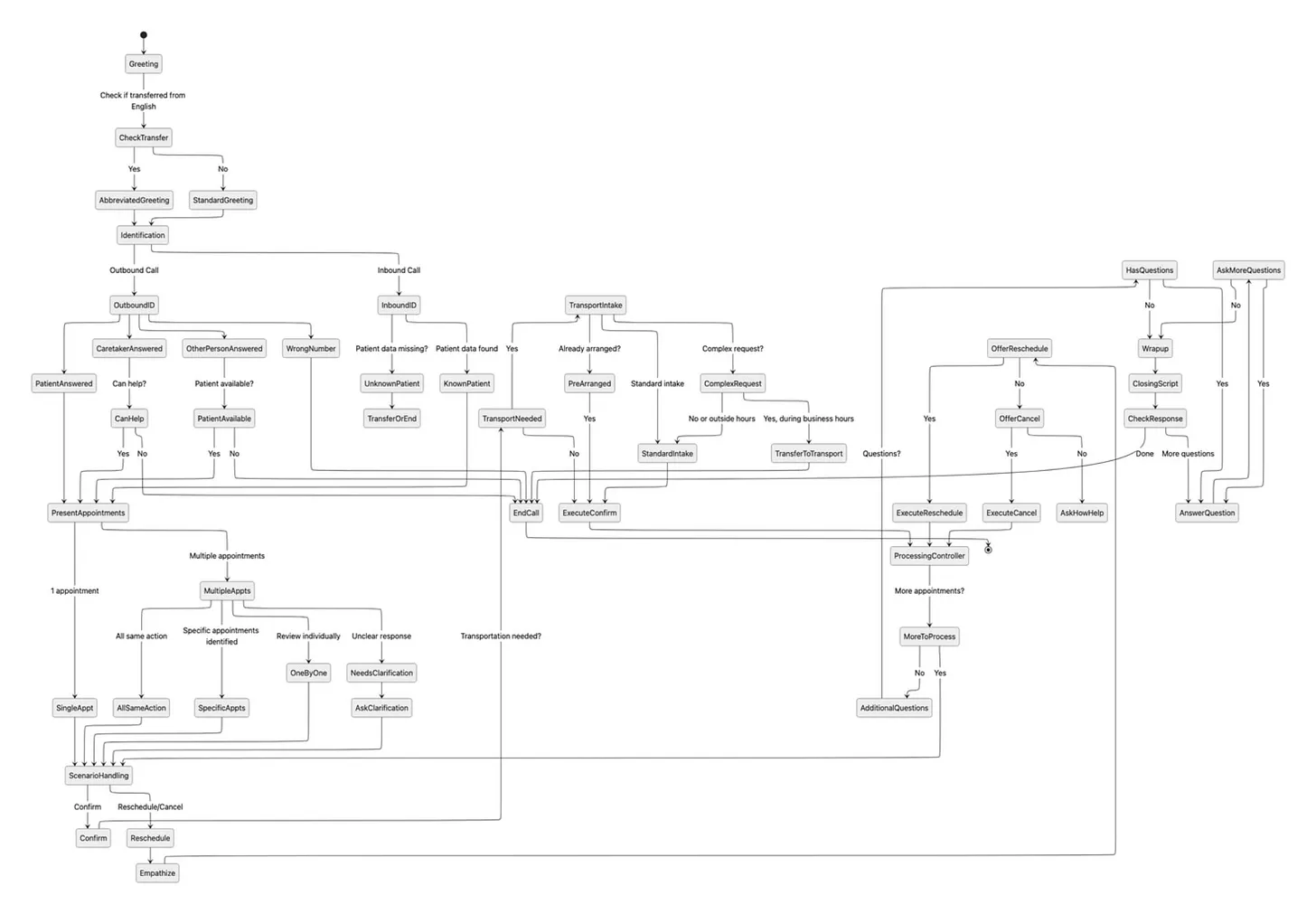
While we think this is overly complicated, this could be solved with a couple of queues, like “New Patient,” “Existing Patient,” “Difficult Questions”, “Arrange Transportation,” etc. With just a couple of people working all of these queues, and with the queues aggregated by employee and ordered by urgency, you can replace this entire ‘workflow’ with one or two people, and have those people cross trained to do several other things. This is efficient.
Rik, we love you, but you’re not a programmer and this is overly complicated and people will fall through the cracks. With a series of queues, nobody will ‘get lost in the system’ and every patient must have some kind of resolution, even if it is getting assigned to another queue, or be marked as complete.
Let’s talk a little more about manufacturing. Each step in a manufacturing process is a queue as above. We have to have all the parts for a step before it is executed. We have to have all the pistons, the block, the crankshaft, the camshafts, ad nauseum before we can complete the engine building step. If the piston guy calls in sick, we need the crankshaft guy or whomever has excess capacity to step in and help out. If the MRI is backed up, we need to increase capacity or cross train to get extra capacity in times of heavy usage.
In addition to the queues we need communication. Every step in a process has to have some kind of resolution. Usually, successfully completed, or assigned to the “Arrange Transportation” queue. Or “CT Scan shows inoperable tumor on thalamus, confirmed with MRI.” This is literally coordination of care. Coordination of care is one of two tenets of Value based care, along with “Deliver Value.” With this kind of system in place, and only with this kind of system in place, can we get to value based care and we turn an eight day hospital stay into a 12 hour hospital stay. Saving instead of wasting those resources is one large way to deliver value based care.
Our basic motivation is to have these queues identify the best use of time between and among each, in a competition for resources, and assign those most critical tasks to individuals in a “worst needs get handled first" kind of way.
Eli Goldratt has a treatise on this subject in his book “The Theory of Constraints” that we have applied here.
Conclusions
We have shown a way to control hospital costs in a way that has not been done in this industry, but with technology that is used in almost all others.
While this only shows the practice or hospital where the money goes, and it is up to them to fix the problem, we here at Sentia will be looking at these financials and ‘helping’ to report them to the government and public in the case of publicly traded and not-for-profit systems. These two categories include the vast majority of hospitals and are where the vast majority of the waste is.
We have built a comprehensive health information system to keep the patient healthy and on the right track with the ability to incentivize healthy living. This system includes the automation of the health insurance industry completely. We have designed and are currently building the ERP style PM system. Implementing this system should be fairly simple and will completely revolutionize the way healthcare is paid for, saving countless lives. We have shown a way to use this system to make the best healthcare system in the world also the most efficacious and the most affordable.
If you liked what you read contact us here, on our site, SentiaHealth.com, our parent company SentiaSystems.com, or send us an email to info@sentiasystems.com or info@sentiahealth.com
Comment
| Date Written | Comment |
|---|