Oracle is in Trouble and Cerner is the Cause
I told you so
Introduction
We normally talk about health care and health insurance in this space and today is no different. Today we are going to talk about Oracle and its Cerner acquisition slowly spiraling the bowl in anticipation of Oracle completely failing.
I told you so.
The Financials
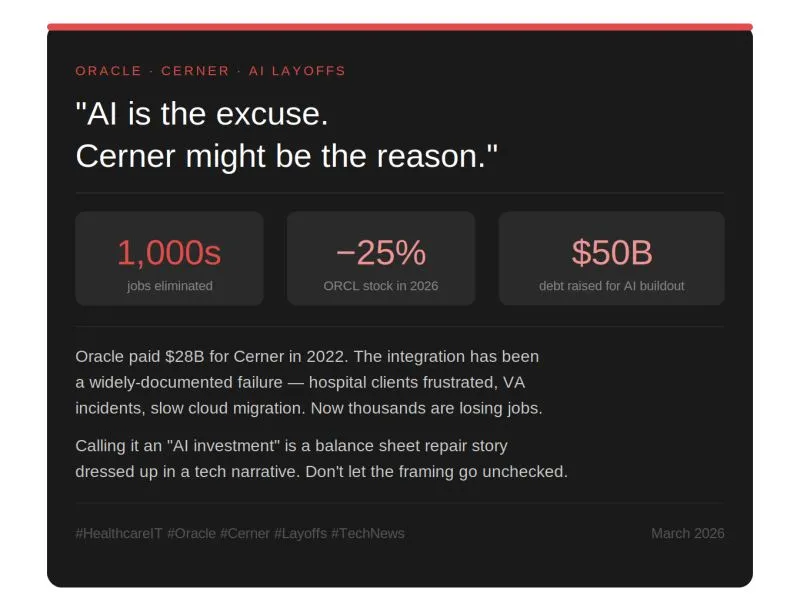
On March 31, 2026, Kris Gates published a post on LinkedIn detailing her perception of what is wrong with Oracle and what she believed the natural outcome to be. Forbes published the latest in a series, this morning, “Oracle’s Massive 30,000 Layoff As AI Spending Surges” detailing massive debt routed to building out AI infrastructure requiring approximately $50 billion in capital spending for fiscal year 2026 alone, $15 billion more than initially communicated to Wall Street. In January, the company announced plans to raise $50 billion in debt and equity to fund the expansion. Its stock has been under pressure from investors concerned about the debt load and dwindling free cash flow.
TD Cowen estimates the layoffs will free up $8 to $10 billion in annual cash flow. Oracle disclosed a $2.1 billion restructuring charge in SEC filings for fiscal year 2026, with $982 million already recorded through the first nine months, primarily for severance. That leaves over $1 billion in restructuring costs still expected before the fiscal year ends on May 31, suggesting additional cuts or facility closures could follow.
The risk is financing. Oracle is smaller than its cloud peers (Amazon, Microsoft, Google) and has been leaning on the debt market to fund its buildout. Operating margins have contracted slightly into the mid-30s as the company spends aggressively. Operating cash flow over the trailing twelve months was $23.5 billion, growing 13% — healthy but modest relative to $50 billion in planned capex.
The difference with Oracle is the company's balance sheet is more constrained than its hyperscaler peers. Amazon and Microsoft generate cash flow that comfortably covers their infrastructure spending. Oracle is raising $50 billion in debt and firing 30,000 people to cover the gap. The strategy makes financial sense if the $553 billion backlog converts on schedule. If contracts get delayed, renegotiated, or cancelled, Oracle is carrying the cost structure of an infrastructure giant without the balance sheet of one.
What happens when the AI boom goes bust and the remainder of those $553 billion in contracts evaporates? What happens when the bust doesn't occur, but the big Venture Capitalists decide to not subsidize the use of AI and actually make some profit and charge compute time plus the profit? Oracle evaporates like morning dew.
What this Means
Oracle has bitten off more than it can chew. Beginning in early 2022, with the $28 billion acquisition of Cerner, they began digging their own collective grave. Here is a company that doesn't understand code, medicine, or apparently anything but hype and finance, trying to do one of the hardest things in the world: build an EMR. There is only one company who has ever built a viable EMR, and it is Sentia.
Oracle is now trying to play in the big leagues with the Microsofts and Amazons of the world, and they just don't have the resources. That means they borrow. When they finally figure out, right about March 31, 2026, that they don't have the "intestinal fortitude" to play in that league, they lay off 30,000 people in an effort to control costs.
Hey Oracle — those were the people keeping you afloat.
You had a few products. They suck, but they were making you profitable, and all you had to do was keep your head down and trudge on. Instead, you had to be the dealmaker, the movers and shakers, and start playing with fire. And now here we are. You can't pay the people to do the work, so you play the VC finance game. There is one difference. You can’t issue an IPO as an exit strategy. You’re already publicly traded. You got played. The real VCs are going to play the hype, issue the IPO and make their money before anyone ever has a real product. When the world realizes that there is no product, these companies will close, the economy will tank and Oracle will go away. I say good riddance; Oracle only ever had one real product and I didn’t like it, their database engine. Nothing else Oracle ever did was worth even looking at.
What is Next?
Oracle is running itself the same way all big companies are run, just with a liberal dose of risk-taking. Here we see more bizdiots making big bizdiot decisions about things they don't understand and can't control. Oracle can't build an EMR. Epic can't even build an EMR. They have tens of thousands of people in a software company. A software company should have a couple or few hundred at most, and many or even most of those are business analysts, project managers, and that kind of thing. If you need more programmers to get a task accomplished, you are building the wrong thing. You are making it more complicated than it really is.
Bringing this back to healthcare, and ignoring the bizdiot consequences, an EMR should be simple, and about data and documenting the patient encounter.
You Don’t Need and Cannot Have Specialties
Here is the beginning of the end for Oracle. Cerner worked for damn near 50 years getting to where they were in 2021. Their basic premise is flawed. You don't need and can't have specialties. What they attempted to do was what the doctors told them to do, instead of analyzing and really solving the problem. Henry Ford famously said, "If I had asked customers what they wanted, they would have replied 'a faster horse'." Cerner worked for over 40 years to produce a faster horse. Oracle followed right in behind them and tried to solve the unsolvable problem and failed. I predicted this then.
One problem is that you have 130 plus medical specialties. That is great, but you don't need 130 plus different programs that all do the same things just with different data to document what doctors do. Your Ford dealership doesn't have an engine documentation system and a transmission documentation system and a suspension documentation system, so why should we have a separate system for medical specialties? I'll submit that you could install the Ford system at the Chevy dealership, and if you swapped the Ford part numbers for Chevy, it would work just fine.
What IS Needed
What we need, then, is a nomenclature that is adequate to the task of documenting the entire patient encounter. This nomenclature is analogous to the part numbers above. With a "part number" for McBurney's sign, Obturator Sign, Rovsing's sign, appendicitis, and appendectomy, we could document the entire patient encounter leading up to surgery. If this nomenclature were indexed and put in a database, we would have a basis for a data driven EMR that has no specialties. Since we have data, we could also automate the entire health insurance industry. The insurance company could just pull data from the medical record and pay for procedures performed in real time. That eliminates medical coding, verification, adjudication, pre-authorization, denials, delays, insurance networks, rate negotiations, sales/brokers/agents, money for a third-party EMR, skyscrapers in every major city, hundreds of thousands of employees, all the monkey business and reduces cost by about half.
It also eliminates Epic/Cerner AND BUCAH.
Read about the entire plan here.
Conclusions
We have shown that Oracle is not a viable company and their bizdiot finance schemes will end them. We have shown that what IS needed is a data driven EMR system that doesn't cater to specialties.
We at Sentia have this EMR in production right now. This isn't a sales pitch, you can't buy it.
This is a reveille, a wake up call to everyone who reads this: the big companies are, and have been for most of a century, going down the wrong path. Solving problems is a worthy endeavor. Oracle is not solving problems, it is complicating them and setting precedent that makes them unsolvable. Finance for its own sake is not solving the problem either. Following the finance bros down the IPO path is disastrous and will probably cause Oracle to file for bankruptcy in the next year or two as the AI bubble bursts and compute goes to pennies on the dollar.
Sentia, on the other hand, has produced the data driven EMR that does not rely on typed-in notes and instead uses data to document patient encounters in a non-specialty kind of way.
Implementing this system should be fairly simple and will completely revolutionize the way healthcare is delivered and paid for, saving countless lives. We have shown a way to use this system to make the best healthcare system in the world also the most efficacious and the most affordable.
If you liked what you read, contact us here, on our site SentiaHealth.com, our parent company SentiaSystems.com, or send us an email to info@sentiasystems.com or info@sentiahealth.com.
Comment
| Date Written | Comment |
|---|