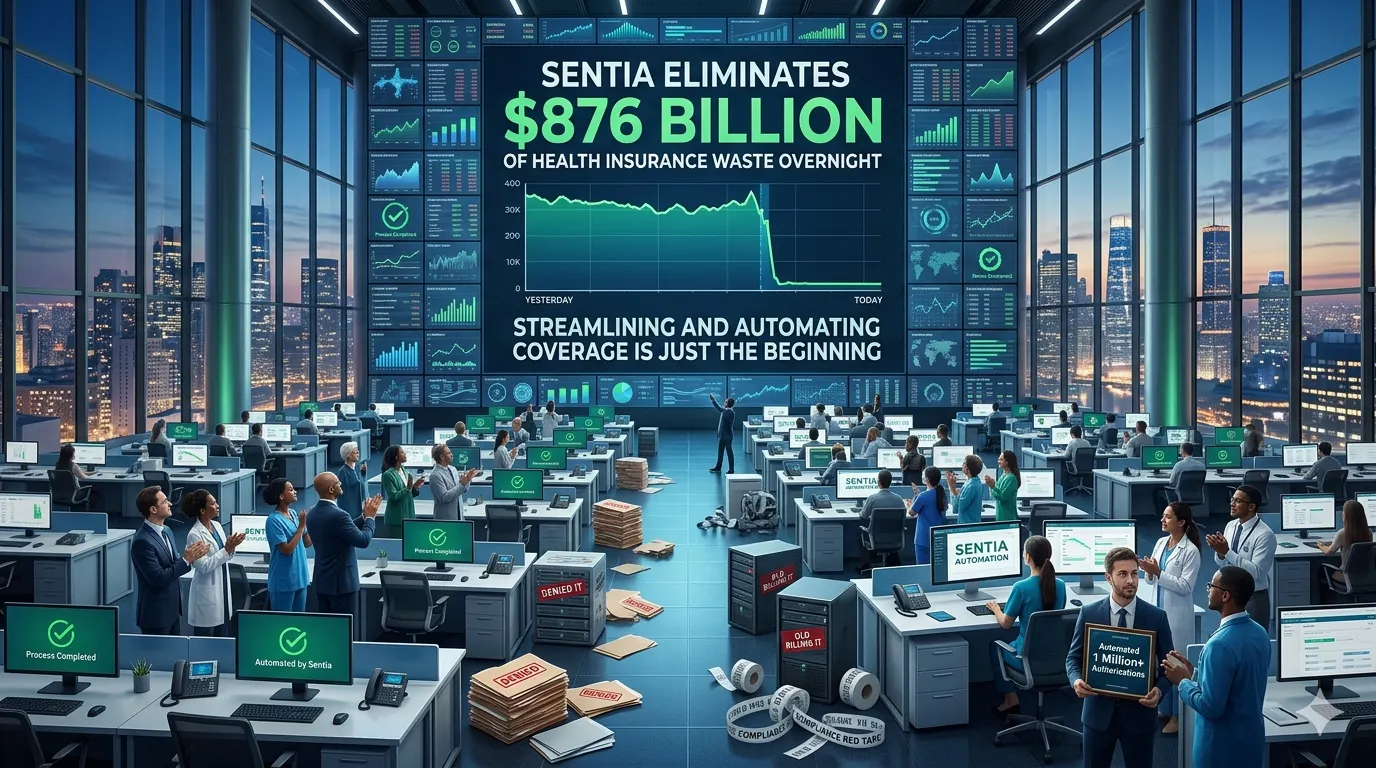
Sentia Eliminates $876 Billion in Health Insurance Waste Overnight
Streamlining and automating the coverage is just the beginning
Introduction
Today we are going to discuss not only the waste, fraud and abuse that is caused by the health insurance industry, but also the integration tax, the chronic disease spend and the waste, price gouging and unnecessary profit at the hospital level. We will show a complete, integrated system to mitigate or eliminate all this waste and how to implement and use it.
The Situation
- US healthcare cost is $5.3T+/year. $4.7T (90%) is behavior-based, avoidable, chronic disease
- Out of $1.4 Trillion spent on health insurance, $876 Billion is wasted (claims, denials, adjudication, coding)
- Integration tax: 25-30% ($265 Billion) of administrative spend is for integration between systems
- Hospital waste
- 25-30% ($25.4 Billion) of supply spending just evaporates
- $12M per hospital ($61 Billion) supply management waste
- Over 1/3 of some operating budgets trapped in handling, storage, restocking
- Expired supplies
- Panic buying during shortages
- Workflow thinking
- One nurse for four rooms (over/understaffing)
- Hospital staff doing anything that isn't delivering care
Logical Conclusion
Healthcare spending in the US is twice or more than it is everywhere else in the world. If nothing changes:
- Premiums keep rising 15-30%/year
- 90% of spend stays on avoidable chronic disease
- Small hospitals go under, large ones keep overcharging
- System collapses
The Short Answer
Four integrated planks:
- Data-Driven EMR
No notes, no coders, auto-bill from SNOMED - Integrated Coverage
Coverage inside EMR, RBP at 150% Medicare - Health & Wellness
Pay patients to improve, 15% discount for compliance - Practice/Hospital Management
Queue-based workflow, one-click Profit and Loss statements for every financial entity
The Slightly Longer Answer
Sentia has produced a platform for all financial facets of medical care, holistically. This platform encompasses and tracks everything that is done in the hospital or practice that isn’t actual medicine
1: Data-Driven, Universal EMR
The data-driven EMR is the only one of its kind, and has these benefits
- No specialties means no 130+different programs to all do the same thing.
Ford dealers don’t have separate engine, transmission and suspension documentation systems, why should medicine? - SNOMED concepts at point of care
no typing text or language based "notes" - No human coders needed
the documentation is already “coded” with SNOMED concepts - VSAC crosswalk → ICD/CPT for legacy insurers
- Eliminates $73,376/year per practitioner in avoidable costs
- No Epic/Cerner at $1B+ per installation
2: Integrated Coverage
Put the coverage right in the EMR and pay for procedures performed in real time
- Coverage lives in the EMR
- RBP at 150% of Medicare
not 400-600% - Instant claims, no adjudication
- No denials, delays, prior auth, networks
- Cuts health insurance costs by 2/3
3: Health & Wellness
Paying for behavior-based, avoidable chronic disease is the largest expense in the US budget. Chronic disease maintenance is $4.7Trilion, more than three times the next largest expense, social security, and five and a half times what we spend on defense.
- Auto-prescribe education based on lab results
- 15% discount for compliance
improved outcomes are demonstrated with better lab results assessment over assessment. - OECD average mortality is 225 deaths per 100,00 for chronic disease. The US is 336, or ⅓ higher. $1.5 Trillion savings when we achieve OECD average
4: Practice/Hospital Management (PHM)
- Queue-based work administration
Most urgent /longest task goes to the longest idle employee - One-click P&L on any entity
Makes finding cash leaks easy - Barcode tracking
supplies, tasks, equipment - Eliminates workflow waste and inventory shrinkage
- Saves hospitals 25%
Conclusions
- 65% savings from coverage integration
- 25% savings from health health and wellness program
- 25% (of hospital costs) savings from PHM
- 25% (of administrative costs) integration tax elimination
We have shown a complete system to dramatically cut the cost of healthcare in the US.
We have shown a way to regulate every financial transaction a practice or a hospital enters into, the Practice/Hospital Management System (PHM). Included with the PHM is a workflow elimination tool that extracts more and better work from employees and streamlines and automates every facet of patient care. All that increases revenue and decreases costs by about a quarter.
We have shown a way to incentivize healthy living in a population and decrease chronic disease and therefore decrease costs for us all in a streamlined and automated manner. This alone has the potential to save $1.5 trillion or about 25% of healthcare spending in the US
We have shown a way to revolutionize the way medical records are thought of, executed, used and searched. This eliminates Epic, all the legacy EMR vendors and makes research a simple pick and click operation, saving millions of lives.
We have shown a way to integrate health coverage into the EMR. The practice or hospital gets paid as the practitioner documents patient care. That eliminates medical coding, verification, adjudication, pre-authorization, denials, delays, insurance networks, rate negotiations, sales/brokers/agents, money for a third-party EMR, skyscrapers in every major city, hundreds of thousands of employees, all the insurance monkey business and reduces cost by about 65%
It also eliminates Epic/Cerner AND the legacy insurers.
It also makes the medical facility leaner, faster, more efficient and more profitable.
Here are additional points detailing the costs incurred by the legacy insurance companies that you pay currently, in addition to wasting about 2/3 of your premium, according to Grand View Research and current as of 2023 and that Sentia would eliminate completely:
Medical Records:
- The average practitioner spends $35,925 annually on electronic medical records
- The average patient spends $106 annually on electronic medical records
- The average patient encounter or visit cost for electronic medical records alone is $32
Medical Coding:
- The average practitioner spends $20,286 annually on medical coding
- The average patient spends $60 annually on medical coding
- The average patient encounter or visit cost for medical coding alone is $18
Compliance and Efficacy Reporting:
- The average practitioner spends $17,165 annually on compliance and efficacy reporting
- The average patient spends $51 annually on compliance and efficacy reporting
- The average patient encounter or visit cost for compliance and efficacy reporting alone is $15
Totals:
- The average practitioner spends $73,376 annually on completely avoidable costs
- The average patient spends $217 annually on completely avoidable costs
- The average patient encounter or visit cost for completely avoidable costs alone is $66
Yes, you read that correctly: $66 per visit. That is more than the practice makes on the average encounter. There must be a better way. There is a better way and Sentia has it.
Remember also that these costs are over and above the 65% your insurance company wastes or shoves into their pockets.
We have designed and are building an ERP style practice/hospital management system that will pinpoint and eliminate cash leaks and inefficiencies in enterprise medical facilities. Implementing this system should be fairly simple and will completely revolutionize the way healthcare is delivered and paid for, saving countless lives. We have shown a way to use this system to make the best healthcare system in the world also the most efficacious and the most affordable.
If you liked what you read contact us here, on our site, SentiaHealth.com, our parent company SentiaSystems.com, or send us an email to info@sentiasystems.com or info@sentiahealth.com.
Comment
| Date Written | Comment |
|---|