You’re Doing It Wrong, Part 10: Remote Work and Return to Office
Nothing says "collaboration" like a two-hour commute to join a Zoom call
Introduction
We are taking a quick step back from healthcare and health insurance to launch a broader series: You’re Doing It Wrong. In this 15-part series, we expose the counterproductive and risky tactics that corporate leaders use—tactics that inflate the cost of their products and services, ultimately passing the bill to you, the consumer. In this tenth installment in the series we are going to explore the lack of thinking behind Return-to-Office initiatives.
Why take a break from healthcare? Simple: there is no real news. The AI hype is just getting worse and will never pan out; the EMR vendors haven't realized that you can't document encounters with text or language; insurance companies rip off everyone, so we are stepping back and looking at the bigger picture. If you need your weekly dose of healthcare, read our article Voice-To-Data Demo: Speak Your Medical Record; No Typing and No Clicks.
The Situation
Corporate leaders cite several justifications for Return to Office (RTO) initiatives:
- Real estate utilization
- Improved collaboration and innovation
- Stronger company culture
- Better productivity oversight
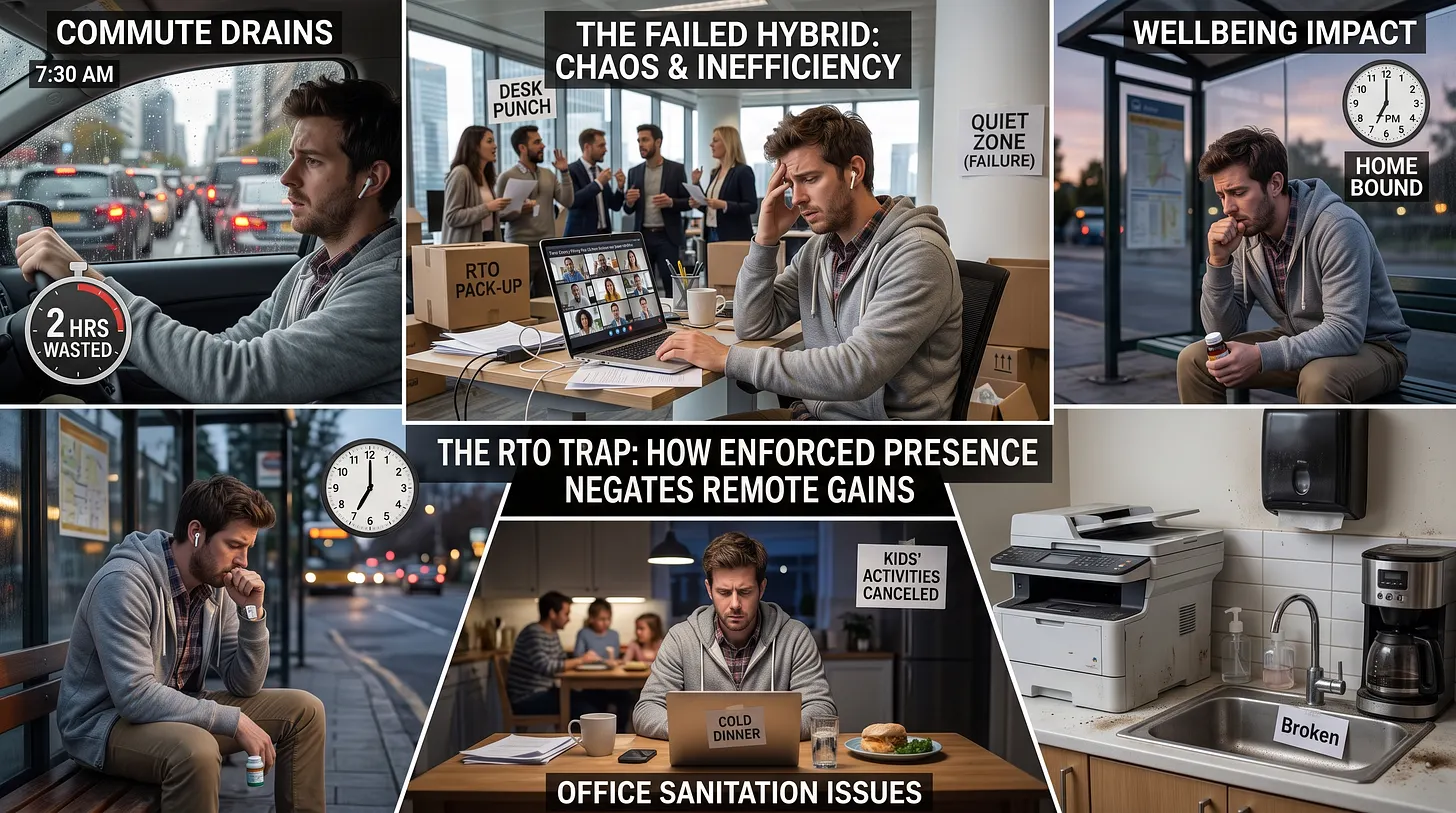
These reasons are not relevant. Real estate is a fixed cost. The 99-year lease your executives signed isn't the employees' fault. You can’t escape it, so eat the cost, shut down the floor, and minimize the burn. Collaboration and innovation happen anywhere. Are leadership teams implying that offshore colleagues lack creative capacity simply because they’ve never set foot in the home office? "Company culture" is empty HR jargon. It exists primarily to justify human resources departments whose actual mandate is ensuring policies are documented well enough to avoid lawsuits. HR functions could easily be replaced by video onboarding and a stipend or ICHRA for employees to source their own health coverage. Finally the real reason for RTO: Productivity oversight. Middle and upper management don’t have the first clue how the sausage is made so the only metric they know to look at is butts-in-seats. This is sad, but it is true. Your management is so out of touch with the work that gets done that they can’t figure out how to affect it at all. They mandate these RTO initiatives in an effort to regain control of a process they never understood in the first place. Meanwhile, rank-and-file workers waste two-plus hours a day adhering to corporate dress codes, burning fuel, and racking up uncompensated wear-and-tear on their vehicles—a complete waste of time, effort, and money.
This all causes your best employees to have low morale and quit. It isn’t the underperformers who leave, they are happy to have any job and won’t jeopardize it. This results in a less productive workforce and time, money and effort lost at the corporate level.
The Logical Conclusion
Since backwards thinking ‘leaders’ have run off their best employees, they are left with the dregs while those who quit have gone to the competition who will allow and encourage working from home. The RTO company suffers productivity losses, while their competition sees productivity gains and increasing revenue and profits.
Employees who can’t quit may engage in resistance tactics like
- Coffee badging
Swiping an ID badge to log presence, grabbing a coffee, and heading right back home. - Malicious compliance
Rigidly following policies to the letter while completely disengaging from actual collaborative problem-solving. - Quiet quitting
Dropping effort to the bare minimum because "butt-in-seat" time is the only metric being evaluated.
The Short Answer
Do not require RTO. That is it. People proved they could be trusted (or not) to work from home. The “or nots” are already gone, the rest of the workforce performs just fine.
The Slightly Longer Answer
RTO mandates have been linked to higher turnover, disengagement and underutilized office space. Leaders should explore other approaches to maintain productivity while offering flexibility. These might include:
- Hybrid work models
Instead of requiring full-time in-office presence, offer hybrid schedules. - Results only work environments
Measure performance by deliverables not butts-in-seats. Employees can choose when and where they work as long as they meet agreed upon goals. - Flexible attendance policies
Allow employees to set their own office days within a framework, or use “core hours” for collaboration while permitting remote work outside those times. - Incentive based office participation
If you must have employees in the office, incentivize them to be there, even if it is simply public transit subsidies, parking or meal stipends. - Digital collaboration tools
Invest in platforms for virtual meetings, project management, and asynchronous communication so teams can work effectively from anywhere - Outcome-based performance management
Shift from attendance tracking to outcome tracking, using clear KPIs and regular check‑ins to ensure accountability without micromanaging location
For employees, make sure you communicate your expectations with management. If you are the best at what you do, and if you aren’t you need to address that first, then you should be able to come to an understanding with your boss.
Conclusions
Once again we have proven that the MBAs are just doing it wrong. There are any number of ways that we can all be happy working together and commands from disconnected middle and higher managers are going to backfire and cost the most valuable employees and maybe jeopardize the very existence of your enterprise.
Remember, this is part ten of a fifteen-part series about how businesses are being run incorrectly by business people who probably haven’t been trained in the intricacies of doing whatever it is that their company does. That however is no excuse for basic incompetence. We are demonstrating not only the problems of modern business, but real, viable solutions.
I will be putting out one or maybe two articles per week. If you liked what you read or want to relate your personal experiences, contact us here, on our site, SentiaHealth.com, our parent company SentiaSystems.com, or send us an email to info@sentiasystems.com or info@sentiahealth.com. By here I mean drop a comment below—feel free to tell me I’m a cotton-headed ninny-muggins—or reach out directly.
Comment
| Date Written | Comment |
|---|