The Case Against Epic: Why the Dominant EHRs Fail Modern Healthcare
From MUMPS and Pajama Time to Simplicity and Data: The Blueprint for a Post-Epic Healthcare Future
Introduction
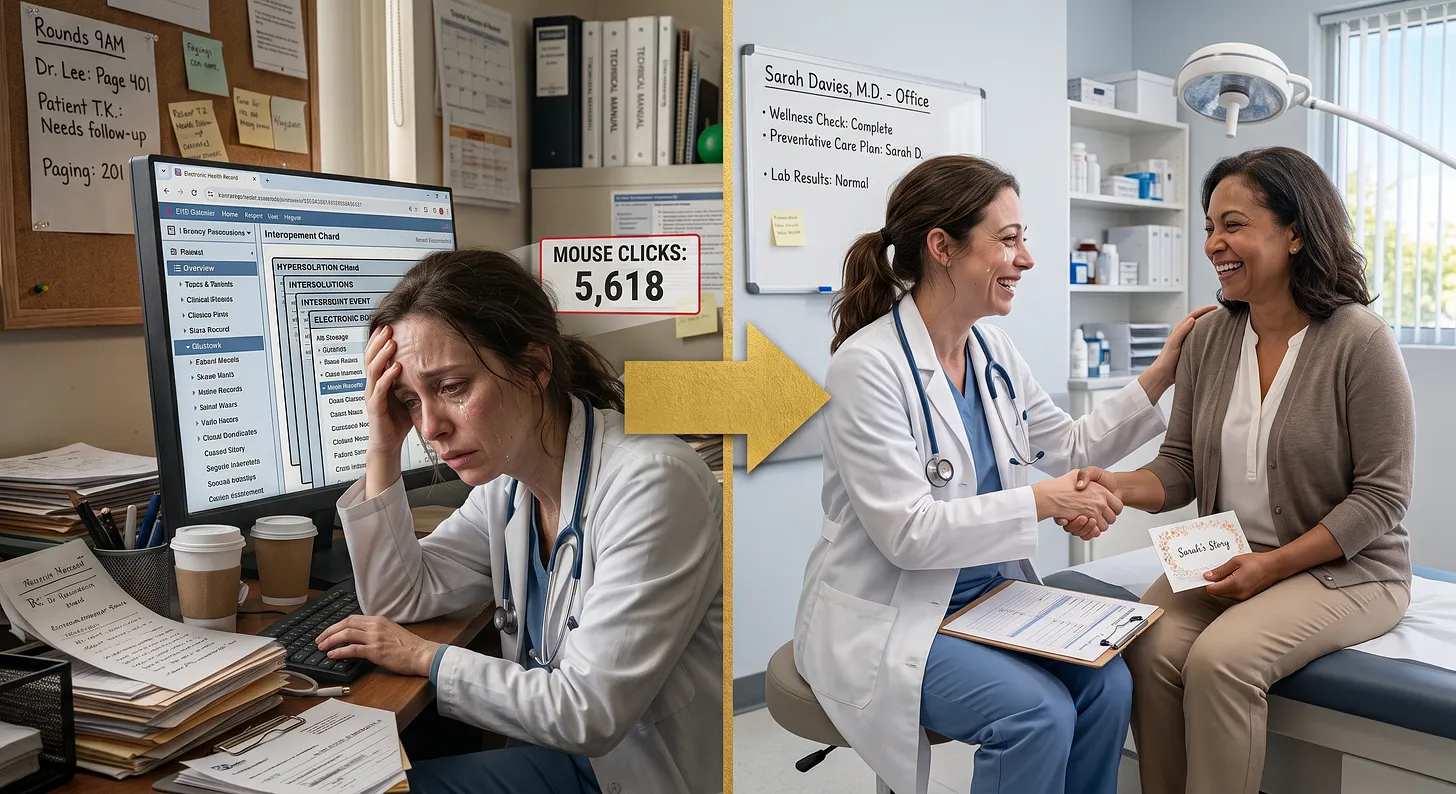
Modern healthcare runs on software built for an era that no longer exists. While health systems invest hundreds of millions of dollars into dominant platforms like Epic, clinicians spend hours buried in administrative paperwork, insurance claims face constant delays, and critical clinical data remains trapped in unstructured text notes.
Epic Systems dominates the health IT landscape, yet its platform faces intense criticism from clinicians, health systems, and software engineers. Examining its database architecture, workflow design, business model, and operational realities reveals a system built on fundamentally outdated foundations and incorrect assumptions.
Today we will lay out the comprehensive case against legacy EMR architecture and present the blueprint for its replacement. First, we examine The Situation: how 1960s database engines, specialty silos, free-text "note bloat," and high-friction business models have brought clinical operations to a breaking point. Second, we present The Solution: a specialty-less, data-driven architecture that replaces narrative text with direct voice-to-UMLS concept ingestion, minimalist relational SQL schemas, zero-trust security, and a language-agnostic data ledger designed for global interoperability.
The Situation
Epic Systems—along with Cerner, AthenaHealth, and the rest of the legacy market—is built on an unsustainable, obsolete foundation. They are not data systems; they are narrative document managers, and in Epic’s case a 60+ year old programming language that has one primary application built in it: Epic.
Built on a 1960s Key/Value Pair Engine (MUMPS)
- Outdated Architecture: Beneath Epic’s Hyperspace UI sits MUMPS (created in 1966). It is a hierarchical tree database, not a modern relational SQL or document database.
- No Real-Time Querying: Because MUMPS cannot efficiently run ad-hoc aggregate queries across clinical fields, health systems must run slow, batch-export ETL pipelines every night just to dump operational data into external relational databases (Epic’s Clarity and Caboodle) to do basic reporting.
- Developer Scarcity & Lock-In: MUMPS relies on single-character, unreadable code syntax. The developer pool is virtually extinct, trapping health systems in total vendor dependency and forcing them to hire certified, high-cost analysts for simple system modifications.
- MUMPS Structural Flaws Beyond Being Old: Epic’s data store lacks true indexes, query planners, transaction logs, relational schemas, or automatic fault recovery. They operate as raw key/value pairs where data integrity is pushed entirely into fragile application code.
The Free-Text Trap and "Note Bloat"
- Document-Centric, Not Data-Centric: Legacy EMRs store patient encounters as unindexed, unstructured text files padded with SmartLinks.
- The "Data Entry Clerk" Rebellion: When EMRs force doctors to click through rigid drop-down menus and point-and-click templates, clinical nuance is destroyed. Doctors revolt and default to dictating or typing massive narrative text walls.
- Pajama Time: Physicians spend up to 2 hours doing administrative data entry for every 1 hour of patient care, driving widespread clinician burnout and forcing hours of late-night charting at home.
The Specialty Silo Delusion
- EMR vendors treat medicine as over 100 disparate industries, writing distinct software modules (Beacon for Oncology, Stork for OB, OpTime for Surgery).
- This fragments the patient record into operational fiefdoms, forcing health systems to pay for separate licenses, separate training programs (taking 6–8 weeks per module), and complex internal translation interfaces.
The Legions of Human Coders
- Because physicians generate narrative text notes, health systems cannot bill insurance directly.
- They must hire massive Health Information Management (HIM) departments and certified medical coders to manually read physician progress notes line-by-line and translate clinical stories into ICD-10, CPT, and HCPCS codes.
The Financial/Monopoly Trap: Epic's "Walled Garden" Revenue Model
- Exorbitant Implementation & Lock-In: An Epic deployment costs anywhere from $100M to over $1 billion. Once a board approves that massive capital expenditure, no CEO will admit it was a mistake. They are locked in for a decade just to amortize the implementation cost.
- Care Everywhere Gatekeeping: Epic’s internal interoperability (Care Everywhere) works well only if both hospitals are on Epic. It functions as an anti-competitive moat, pressuring independent clinics and regional hospitals to buy Epic just to share records with the local health system.
- The "Certified Analyst" Tax: Health systems are forced to maintain huge teams of internal, highly paid certified analysts just to tweak basic screens, turning software support into a massive recurring revenue drain.
- Infrastructure and Server Bloat: Legacy EMRs force health systems to buy, host, and maintain massive on-premise server farms or pay exorbitant monthly fees for private cloud virtual machines (VMs). Managing local databases, operating system patches, and hardware redundancy creates a huge, ongoing IT expense before a single patient is even treated.
Why "Ambient AI" Cannot Fix It
Health systems try to patch this nightmare by layering "Ambient Listening AI" on top of Epic. This introduces fatal risks:
- LLM Hallucinations & Liability: Generative models routinely mishear, invert, or fabricate clinical facts (e.g., confusing "denies chest pain" with "reports chest pain"). Because the physician is legally accountable for signed charts, line-by-line verification of AI transcripts takes as much time as typing.
- Wiretapping & Consent Laws: Recording encounters violates two-party wiretapping laws if patients refuse consent or if emergency care makes consent impossible.
- Missed Unstated Cognition: Patients speak non-linearly, and much of a doctor's diagnostic reasoning is internal cognitive observation that is never spoken aloud during an exam.
- Legal Discovery Risk: Storing permanent raw audio and transcripts exposes health systems to massive malpractice litigation discovery.
- Ambient AI records chatter; Dictation records clinical intent.
- When a doctor talks to a patient, 80% of the conversation is rapport, social chit-chat, or rambling history. Ambient AI tries to sift through that noise and guess what mattered.
- Direct dictation captures the physician's synthesized clinical decision-making ("Chronic cough probably due to lisinopril; doubt pneumonia..."). It forces zero clicks, but still records the provider's deliberate, filtered judgment rather than raw conversational noise.
The Workflow Customization Trap
- Vendor Customization Bloat: Legacy EMR vendors pitch "custom workflow design" as a feature. The reality is that this results in massive software forks, fragile code bases, and endless training sessions. Every department demands custom screens, templates, and buttons, which explodes system complexity and drives maintenance costs through the roof.
Conclusion to The Situation
The failures of modern health IT are not isolated software bugs; they are the unavoidable result of a fundamentally flawed architectural premise. Whether evaluating Epic, Cerner, AthenaHealth or any other legacy system, vendors remain glorified document managers built to archive clinical narratives rather than process structured data. Layering generative AI or ambient listening on top of these obsolete platforms only adds cost and legal risk without solving the root problem.
With the exception of the MUMPS programming language itself, every legacy medical records vendor shares these exact architectural limitations. Healthcare does not need another incremental overlay or interface engine. It requires a fundamental shift from narrative document management to a deterministic, structured data ledger.
There has to be a better way.
The Solution
The Architectural Blueprint: A Universal, Data-Driven, Specialty-Less EMR
To replace Epic, we discard text blobs, specialty modules, and generative AI hallucinations. We replace them with Deterministic Voice-to-Data Ingestion writing directly to a Minimalist Relational SQL Schema.
The Core Relational SQL Schema
Demographics sit in an external Master Data Management (MDM) database, and visual files (DICOM, photos) reside in a dedicated media app. The core EMR clinical database consists of just a few normalized tables.
- PatientEncounter: Stores the event anchor (PatientEncounterId, PersonGuid, SourceId, PatientEncounterDate).
- PatientEncounterConcept: The universal data ledger (UMLSCUI, UMLSTR, UMLSSAB, SOAPTypeId, Ordinal, ParentPatientEncounterConceptId, Value) in whatever language they were spoken in.
- No Specialty Modules: An EKG reading, a blood pressure value, a psychiatric score, or a rash diagnosis are all stored as standardized rows in PatientEncounterConcept. The database structure never changes; the UI simply filters views based on the provider's needs.
- Elimination of Customization Bloat: Custom departmental workflows are eliminated at the database level. Because all data maps to standardized universal concepts, specialty "workflows" become simple, lightweight UI screen preferences accomplished via configuration, rather than expensive custom software builds.
- Hierarchy via Self-Reference: ParentPatientEncounterConceptId allows building infinite concept trees natively in SQL (e.g., Parent Record: “Abdominal Pain” to Child Record: “Lower Right Quadrant”).
- Provenance and Staging: Source & ImportFileType act as the staging ingestion point for raw incoming notes/payloads before parsing, maintaining complete provenance.
- Media Handling: Smartphone photos of a rash, wound, or bruise drop straight into cloud object storage. The EMR merely stores the media pointer/URL in Source, keeping the SQL engine fast and lightweight.
Relational Multitenancy & Zero-Trust Database Security
- Company-Based Isolation: Multitenancy is enforced relationally rather than cluttering every table with a TenantID. Patients, clinicians, and administrative staff are all modeled as Person entities within the external Master Data Management (MDM) platform, tied relationally to a Company (e.g., a practice, clinic network, or hospital system).
- SessionGUID & JWT Verification: Every API call and database query requires an active SessionGuid, passed as a claim inside a validated JSON Web Token (JWT).
- Stored-Procedure Gatekeeping: Base tables are completely locked down and inaccessible to normal database users. All data access occurs exclusively through Stored Procedures, which take SessionGuid as their mandatory first parameter and validate it against the active session before returning or modifying a single row.
- Unified Single Sign-On (SSO): Global identity and UserType permissions are maintained in a master SSO authority, which synchronizes down to local User tables across every database application in the suite, ensuring strict role-based access control (RBAC).
- Fully Self-Contained Cloud Architecture/Zero Infrastructure Requirement: Practices do not need on-premise servers, local database administrators, or expensive private cloud virtual machines. Everything is built natively into Sentia Health and fully managed in the cloud.
- Internet Connection Only: Practices and health systems require zero software installations, hardware provisioning, or IT maintenance. The entire system is accessible out of the box from any device with an internet connection, eliminating infrastructure overhead almost entirely.
The Input Engine: Direct Voice-to-Data (Sentia Method)
Instead of typing, clicking, or using generative AI, the clinician speaks naturally in full clinical paragraphs. The engine parses the voice stream directly into UMLS structured data in real time:
- Deterministic UMLS Mapping: The spoken word is compared directly against the Unified Medical Language System (UMLS) provided by the NIH, mapping terms instantly to standardized CUIs (linking SNOMED-CT, RxNorm, LOINC, and ICD-10 natively).
- Zero Hallucinations: It is a rule-and-ontology comparison engine, not an unconstrained generative LLM guessing the next word.
- Negation & Modifiers: Spoken negations ("denies fever, chills, hemoptysis") automatically attach prohibition flags (Negation = TRUE). Spoken certainty ("cough probably due to lisinopril... doubt GERD") automatically attaches certainty modifiers (PROBABLY, DOUBT, CONSIDERED).
- Zero Clicks: A 45-second dictation parses into hundreds of structured database concepts with zero manual menu navigation or typing at all.
The Benefits: What Native Data Unlocks
When clinical encounters exist as normalized, deterministic UMLS database rows rather than narrative text notes, healthcare operations achieve full automation.
Real-Time Health Insurance Automation & Payer Read-In
- API Adjudication: Because every procedure, diagnosis, and medication is stored as a validated UMLS concept with explicit negation/certainty modifiers, the payer's system can query the encounter stream via API the moment the clinician signs off.
- Instant Prior Authorizations & Payment: Payer algorithms evaluate structured criteria instantly (e.g., Is Lisinopril marked discontinued due to Cough? Yes: Authorize Valsartan instantly). Claims are paid automatically upon visit completion, bypassing the entire billing/denial cycle.
- Fraud Elimination: Eliminates "upcoding" and keyword-stuffed text notes, providing an unalterable, verifiable record of what was actually evaluated.
- More than 25% Overhead Reduction: By slashing insurance friction (claims, rejections, payment delays, prior authorization loops, even medical coding) and utilizing structured work-distribution queues to reduce manual administrative labor, practice overhead drops by over 25%.
- Pay-As-You-Go Economics: Replaces multi-million-dollar upfront implementation traps with a simple, transparent pay-as-you-go model at ~$1 to import a legacy record or create a new patient chart.
Fully Automated Downstream Processing
- Zero-Human-Intervention Orders: Because the dictation parser captures Action: Discontinue Lisinopril, Action: Start Valsartan 160mg, and Action: Order CT Lung Screening as discrete data points, those transactions automatically fire off to e-Prescribing, Laboratory, and Scheduling modules instantly upon sign-off without manual order entry.
- Epic death by a thousand clicks: In Epic, a doctor still has to open an order entry menu, search for Valsartan, click the dose, select the pharmacy, and sign the order.
- Sentia’s Voice_to_Data: In the Sentia method, spoken intent ("Will start valsartan 160mg daily") populates the e-Prescribing queue with the correct drug, dosage and delivery method automatically during parsing, reducing ordering to a single visual confirmation.
Instant Population Analytics & Medical Research
- Millisecond SQL Queries: Negations and certainty modifiers are native database columns. Complex clinical research queries execute instantly using standard SQL without needing slow NLP parsers or night-batch Clarity exports.
- Instant Population Analytics and Medical Research: Because negation (Negation = FALSE) and certainty (Modifier = CONSIDERED) are explicit columns, trial algorithms can instantly screen millions of records for trial candidacy without paying human chart abstractors to manually review PDF notes.
- Deterministic Risk Calculation for Value-Based Care: Because every diagnosis, intervention, and lab value is captured as a discrete concept, health systems and accountable care organizations (ACOs) can calculate real-time Per Patient Per Month (PMPM) risk metrics deterministically—enabling accurate value-based care contracts without relying on delayed, estimated insurance claims data.
Multi-View Rendering & Universal Interoperability
- Multi-View Engine: The single structured UMLS dataset can be rendered on the fly as a graphical SOAP view (with negation icons), a JSON payload for native API exchange, an ephemeral narrative text summary for legacy systems, or auto-generated ICD-10/CPT codes for legacy insurers.
- HL7 & FHIR Critique: HL7 relies on complex, rigid "channels" and file formats. FHIR is essentially the same outdated HL7 messaging model wrapped in a modern API. Neither provides native data structure; both rely on messy mapping pipelines. Self-defining hierarchical payloads (e.g., JSON representing object graphs) eliminate HL7/FHIR channels entirely.
- Integrations as an Invisible Tax: Legacy EMRs separate clinical charting, practice management, billing, and scheduling into distinct applications. Connecting these via interfaces introduces an ongoing "integration tax"—endless maintenance, sync failures, and vendor middleware fees.
- True Interoperability: Transferring records between health systems means sending lightweight, clean JSON payloads of only 6-8 properties of UMLS CUIs that any modern application can ingest natively—ending the era of unreadable 100-page PDF document dumps, unintelligible HL7 files/streams and over-complicated FHIR feeds.
Multilingual Capabilities (Language-Agnostic Core)
- Native Translation: Because UMLS Concept Unique Identifiers (CUIs) are universal numerical keys, a physician can dictate an encounter in Spanish, French, or Japanese, and the system maps it to CUI C0010200.
- Global Portability: Another doctor (or an American insurance payer) can view that exact same record instantly rendered in English. You get real-time cross-language medical interoperability for free without needing translation services.
The Only Valid Foundation for a Universal World Health Record
- Globally Portable Data Ledger: Because clinical encounters are captured using universal UMLS Concept Unique Identifiers (CUIs)—rather than localized, dialect-bound narrative text—this architecture serves as the foundation for a global, cross-border health record.
- Universal Translation: A patient's medical history dictated in Tokyo, Paris, or New York maps directly to identical standardized concept IDs. If that patient travels or moves, their clinical record translates instantly into the local language of any receiving provider worldwide, providing true global interoperability without third-party translation software.
Conclusion: The Deterministic Future of Healthcare
The dominant EMR paradigm has reached its technical and operational limit. By continuing to treat clinical encounters as unstructured text documents locked within specialty silos, legacy platforms force health systems to rely on legions of human coders, slow ETL pipelines, and endless integration interfaces simply to move basic data.
The blueprint outlined here proves that a better model is not only possible, but technically superior in every operational metric:
- Data over Documents: Replacing text blobs with normalized UMLS concept rows establishes a real-time, queryable database ledger.
- Direct Intent over Ambient Noise: Capturing synthesized clinician decision-making via direct dictation eliminates click fatigue and LLM hallucination risks simultaneously.
- Zero-Trust Security & Multitenancy: Validating session GUIDs at the stored-procedure level guarantees strict tenant isolation and role-based data control.
- Automated Operations: Native concept data unlocks instant prior authorizations, zero-human-intervention order processing, real-time population risk analytics, and seamless cross-border translation.
By discarding 1960s key-value stores, specialty modules, and predatory licensing fees in favor of a pay-as-you-go relational core, this architecture replaces the legacy "walled garden" with a true Universal World Health Record. The era of the narrative document manager is over; the future of healthcare belongs to deterministic, native data.
If you liked what you read or want to relate your personal experiences, contact us here, on our site, SentiaHealth.com, our parent company SentiaSystems.com, or send us an email to info@sentiasystems.com or info@sentiahealth.com. By here I mean drop a comment below—feel free to tell me I’m a cotton-headed ninny-muggins—or reach out directly.
Comment
| Date Written | Comment |
|---|