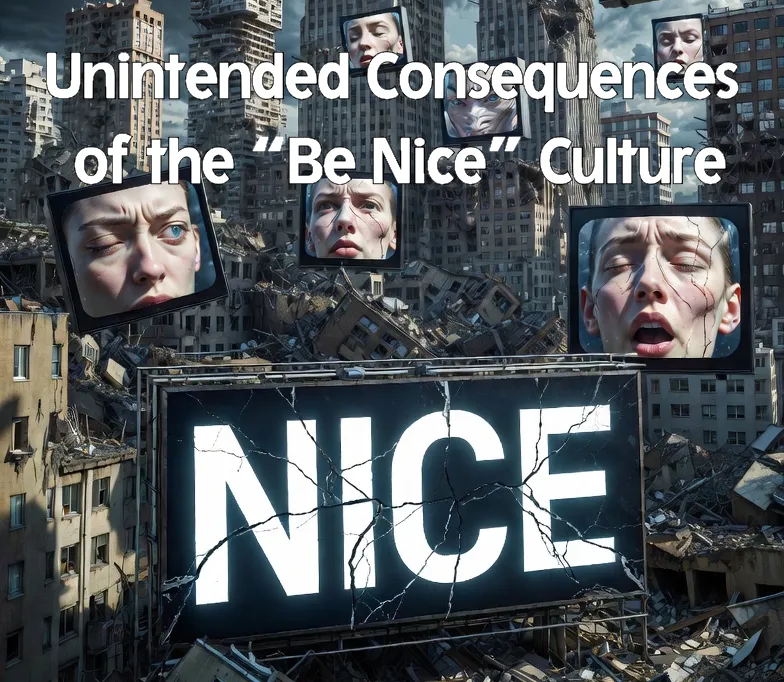
Unintended Consequences of the “Be Nice” Culture
If you want success, or even to just get things done, nice is not the answer
Introduction
Normally, we discuss healthcare and health insurance in this space, but today we are exploring a different topic: the emphasis on “be nice.” This cultural imperative can sometimes hinder progress. As Niccolò Machiavelli observed in The Prince, "A man who wishes to make a profession of goodness in everything must necessarily come to grief among so many who are not good." This highlights the risks of unwavering virtue in a complex world. Arthur Schopenhauer noted that "Politeness is to human nature what warmth is to wax," suggesting that excessive politeness can soften resolve and obscure truths. Dietrich Bonhoeffer, reflecting on societal challenges, stated that "Stupidity is a more dangerous enemy of the good than malice," emphasizing how unexamined beliefs can impede advancement. In this piece, we will examine these ideas to understand when prioritizing niceness may limit effective outcomes.
Case Studies
In this section, we will review hypothetical scenarios to analyze why certain approaches may not yield expected results, particularly when a culture of niceness avoids necessary critique. People cozen to belief instead of proof, which can undermine informed discourse. This aligns with Bonhoeffer's view of stupidity, where "reasons fall on deaf ears; facts that contradict one’s prejudgment simply need not be believed." A focus on niceness may inadvertently allow such views to persist, as Schopenhauer's analogy implies politeness can soften the delivery of corrective information. Machiavelli's pragmatism suggests learning "how not to be good" in such cases to address misinformation effectively.
Conspiracy Theorists
Conspiracy theorists often adhere to unsubstantiated claims, which can undermine informed discourse. This aligns with Bonhoeffer's view of stupidity, where "reasons fall on deaf ears; facts that contradict one’s prejudgment simply need not be believed." A focus on niceness may inadvertently allow such views to persist, as Schopenhauer's analogy implies politeness can soften the delivery of corrective information. Machiavelli's pragmatism suggests learning "how not to be good" in such cases to address misinformation effectively. Nietzsche might argue that excessive politeness here shields immoralist undercurrents from scrutiny. The reality is that some need to be told to just shut up.
Anti-Vaxxers
Individuals who reject vaccinations may lack a full understanding of scientific principles, potentially posing risks to public health. This is not a context for unchecked politeness; rather, experts should assert evidence-based guidance. Bonhoeffer noted, "Against stupidity we are defenseless. Neither protests nor the use of force accomplish anything here," unless we move beyond superficial niceness. Strategies like education or targeted interventions could encourage reevaluation. Machiavelli reinforces this with, "All courses of action are risky, so prudence is not in avoiding danger (it's impossible), but calculating risk and acting decisively." Stoic philosophy warns that being overly polite can make one a target for exploitation, emphasizing boundaries in interactions. In this case, it is time to not be nice and to hold people down and give them vaccines without regard for their beliefs. Proof reigns supreme.
Flerfs
Adherents to flat earth theories maintain views contrary to established evidence. Such beliefs may endure due to a reluctance to challenge them directly. André Comte-Sponville, in his treatise on virtues, describes politeness as a "virtue of pure form," which can sometimes prioritize appearance over substance. In short, show these not-bright individuals how the math actually works and the actual experiments done by Eratosthenes nearly 2500 years ago proving the earth is spherical.
Snowflakes
Yes, things are a little more difficult now than they have been at the best of times. No, whining about it isn’t going to help. Contemporary challenges may feel amplified, but complaints without action do not resolve them. Consider the Great Depression, when hardships were met with resilience. Schopenhauer's view suggests politeness can soften our response to adversity. Bonhoeffer described stupidity as leading to self-satisfaction. Machiavelli advised, "Whosoever desires constant success must change his conduct with the times." Adaptation, rather than niceness, fosters progress. Utilitarian ethics might weigh the greater good of direct feedback over polite avoidance. Being nice to snowflakes, then, just encourages them to complain and not actually go achieve anything.
“Let me be Honest”
Honesty serves as a counterbalance to excessive niceness. Bonhoeffer emphasized that overcoming stupidity requires liberation, not mere instruction. Schopenhauer viewed politeness as altering human nature subtly. Machiavelli advocated using or refraining from goodness as needed. Prioritizing candor can drive meaningful change. Virtue ethics encourages balancing compassion with integrity. “Let me be honest,” however, is a sure indication that something rude and offensive is coming next; the wolf in sheep’s clothing about to rip out your proverbial throat.
Nice as a Substitute for Competence
Acknowledging someone's niceness is positive, but it does not equate to value creation for society. Competence requires delivering tangible contributions. Schopenhauer's analogy highlights how politeness can mask deficiencies. Machiavelli cautioned that trying to be good constantly leads to downfall. The School of Life suggests polite individuals often suspect their own darker impulses, leading to overcompensation. “Yes, but it was nice when I presented my proposal!” Your proposal was crap and nice has nothing to do with it.
Nice as a non-sequitur to end arguments
In debates, invoking "be nice" can serve as an irrelevant interjection that derails logical discussion without addressing the merits. This fallacy occurs when politeness is used to shut down arguments, as premises become wholly irrelevant to the conclusion. For instance, during a policy discussion, responding with "just be nice" avoids substantive engagement, similar to avoiding the issue or question. Nietzsche could critique it as a mask for underlying power dynamics. Kantian ethics would prioritize truth and duty over compassionate but dishonest deflection. Rules for rational argumentation prohibit such irrelevant appeals, ensuring discourse remains focused. That means if you tell me to be nice, I am not going to be nice and the “be nice” sayer is going to be the first target.
Outcomes
In a culture overly focused on niceness, several negative consequences emerge, affecting personal growth, organizational dynamics, and societal progress. Drawing on diverse philosophical perspectives, the following subsections explore these outcomes in depth, highlighting how unchecked politeness can undermine essential elements of human interaction and advancement.
Feedback as Fluff
When niceness dominates, feedback often devolves into superficial compliments or vague suggestions, lacking the substance needed for genuine improvement. This diluted form of communication prioritizes harmony over helpfulness, resulting in missed opportunities for development. As organizational psychologist Adam Grant observes, “Withholding feedback is choosing comfort over growth,” emphasizing that true progress requires candid input rather than polite evasion. Similarly, leadership expert Ken Blanchard notes that “Feedback is the breakfast of champions,” but only when it is direct and actionable; otherwise, it becomes mere fluff that starves potential. In Kantian terms, this superficiality violates the duty to treat others as ends in themselves, denying them the honest critique needed for autonomy and self-improvement. Utilitarian thinkers like John Stuart Mill would argue that such feedback fails to maximize overall utility, as it perpetuates mediocrity instead of fostering excellence. Expanding on this, research in communication ethics suggests that polite but insincere praise can erode self-awareness, leading individuals to overestimate their abilities and stagnate professionally. To counteract this, embracing Stoic principles from Epictetus—focusing on what is within our control, like delivering truthful guidance—can restore feedback's value as a tool for resilience and growth. Being blunt, tell me what you think I did wrong, in no uncertain terms. The candor will be appreciated.
Accountability Vanishes
Without direct address, responsibility fades, as polite avoidance enables excuses and deflections rather than ownership. This erosion of accountability weakens social and professional bonds, allowing lapses to go unchecked. Philosopher Stephen Darwall argues that accountability is intrinsic to moral obligations, where being answerable to others forms the basis of ethical relationships; excessive niceness disrupts this by prioritizing comfort over confrontation. In Aristotelian virtue ethics, accountability emerges as a mean between recklessness and cowardice, requiring courage to hold oneself and others to standards. Kant's categorical imperative reinforces this, demanding that we treat humanity as an end, which includes enforcing accountability to prevent exploitation. Utilitarians like Jeremy Bentham would view vanished accountability as a failure to promote the greatest good, as it leads to inefficiencies and harms in collective endeavors. Expanding the discussion, contemporary ethicist Jesse Couenhoven describes accountability as a forward-looking virtue, where embracing answerability fosters personal excellence and communal trust. Stoic thinker Seneca advised directness in friendships to build character, warning that polite silence allows vices to flourish unchecked. In organizational contexts, this manifests as "radical candor," where avoiding tough conversations due to niceness leads to systemic failures.
Stagnant Innovation
Unchallenged ideas lead to inertia, as a "be nice" culture discourages the robust debate necessary for breakthroughs. This complacency stifles creativity, trapping individuals and groups in outdated paradigms. Socrates emphasized dialogue to challenge assumptions, reminding us that innovation thrives on diverse viewpoints and rigorous questioning. Nietzsche's "will to power" frames innovation as an ambitious drive to overcome limitations, where politeness can hinder the creative destruction needed for progress. Pragmatist William James contrasted with Kant's categorical imperative, advocating experimentation over rigid principles to adapt to change. F. Scott Fitzgerald noted, “The test of a first-rate intelligence is the ability to hold two opposing ideas in mind at the same time and still retain the ability to function,” highlighting how niceness avoids such tension, leading to stagnation. Expanding this, non-standard philosophy critiques innovation's essence, urging ethical considerations beyond mere novelty. In business, Elon Musk's "infinite why" method, endless questioning of assumptions, mirrors philosophical inquiry, fostering disruptive innovation over polite acceptance.
Trust Erodes
Insincere politeness undermines credibility, as it conceals true intentions and breeds suspicion. Over time, this facade erodes the foundation of reliable relationships. Cicero's concept of sinceritas portrays sincerity as pure-hearted truthfulness essential to moral uprightness, contrasting with polite artifice that fosters distrust. Emily Dickinson advised, "Tell all the truth but tell it slant," suggesting that direct yet tactful honesty preserves trust better than bluntness or evasion. William Gilmore Simms asserted, “The only true source of politeness is consideration,” implying that genuine empathy builds trust, while superficial manners do not. Aristotle viewed courtesy as a virtue balancing rudeness and flattery, where excess politeness becomes insincere and damages authenticity. Expanding on this, Kantian ethics prioritizes duty-bound truth over compassionate deflection, as dishonesty—even polite—violates universal respect. In utilitarian analysis, polite dishonesty risks long-term cynicism, reducing overall societal well-being. Psychological insights confirm that sincere interactions boost oxytocin and connection, while polite masks lead to alienation.
Conclusions
While well-intentioned, an overemphasis on niceness can inadvertently stifle progress by protecting unhelpful views. Insights from Machiavelli, Schopenhauer, Bonhoeffer, Nietzsche, Stoicism, and ethical traditions like utilitarianism and Kantian ethics advocate for a balanced approach: blending courtesy with pragmatism, honesty, and critical engagement. As Machiavelli noted, prudence involves "calculating risk and acting decisively." By valuing substance over surface-level niceness, we can foster genuine advancement.
If you liked what you read contact us here, on our site, SentiaHealth.com, our parent company SentiaSystems.com, or send us an email to info@sentiasystems.com or info@sentiahealth.com
Comment
| Date Written | Comment |
|---|