You’re Doing it Wrong Part 2: Installed Applications
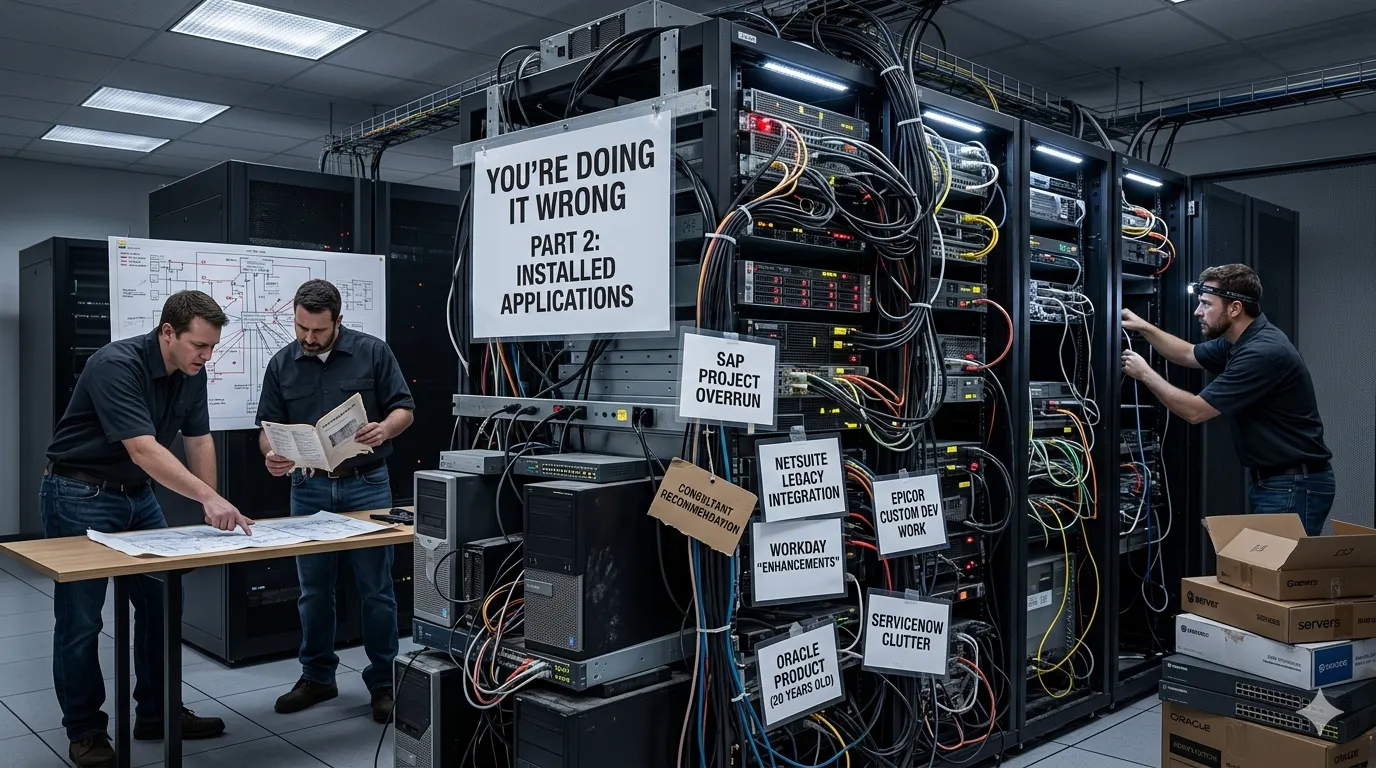
Any applications that you have to host or finish or integrate, really
Introduction
This is part 2 in our 15 part series “You’re Doing it Wrong” that details how businesses in general are going down the wrong path in, well, 15 large ways. This week, we will discuss why installed applications or any applications for that matter, are not the best thing to do nor the brightest way to run your business.
The Situation
Your business, or the businesses you purchase from buy a set of business applications that are pitched by large companies with wild hordes of marketers and slick salesmen. These armies of people are tasked with doing one thing: make you spend money on things you don’t want or need. We aren’t talking about Microsoft 365 or Google Docs, though these have their own problems, at ~$15/month they just don’t matter. We are talking about SAP, NetSuite, Epicore, Workday, Salesforce, ServiceNow, or anything that Oracle has produced in the past 20 years. Companies hire consultants, the consultants recommend buying, rebuilding and installing these applications and your business, or the businesses you buy from, spend millions or more on infrastructure, development and support. Let’s dig into the real costs.
Infrastructure
This includes all the servers, all the switches, all the cabling, the firewalls, all the hardware that it takes to run a modern enterprise application on. If you run on premises, it only costs about 25% of running it in the cloud. You have to have all the people with all the knowledge to make these things work too.
Development
Even after you purchase these applications you need legions of developers to modify and configure one of these ‘enterprise’ applications. Can someone please explain to me why you buy Computer Off The Shelf (COTS) software and then have to hire dozens of architects, project managers, business analysts and developers to finish someone else’s product? This is a little like buying a new car and then having it come in a box that you have to assemble, with a few pieces missing. Engine and transmission are the responsibility of the purchaser.
Support
Even after you have all the work done and everything is up and running perfectly and successfully, You still have to have support people to watch over your servers and network and all the things that salesman told you to buy. On top of that, you have to have a support contract with the vendor that generally runs about 20% of the purchase price. Finally, your support contract doesn’t cover basically anything, because your new team wrote half the application and will always get the blame. This means you have all the resources mentioned in the Development section above, in perpetuity.
Integration
Wonderful, now you have all your new, shiny applications installed and running and they don’t talk to each other. These things are worthless unless they can communicate with each other. So now you have to task the teams we talked about earlier with figuring out a way to use the data contained in all those little point solutions to actually run your business. It certainly seems like you are in the software development business instead of whatever business you thought you were in.
The Logical Conclusion
You have spent all the money on all the things detailed above and you still can’t tell how much your widget costs to produce. You can’t tell if you should buy that new machine, or if the old machines like it are adequate or even making you money. You are still (wrongly, the subject of last week’s article) emailing spreadsheets exactly like they did at Lloyd’s of London in 1689, or ancient Sumeria almost 10,000 years ago, just without the networking. They actually had to get their hands dirty and schlep the spreadsheets around, but spreadsheets there were, and schlepping there was, and you are doing the same thing in spite of all your fancy, expensive solutions.
These installed solutions are killing your business. Either you get no value, or you have to do the four steps outlined above and spend millions and take years and then and only then do you get the benefit. I can hear all of you that have made these mistakes yelling “There is no benefit!” That is probably true. I suspect that one out of thousands actually get these boondoggles configured and talking to each other in any meaningful way.
That means the vast majority of you are spinning your wheels and wasting valuable resources and eventually, as the salesmen convince you to buy just one more thing, your company will fail.
Read that again.
Your company will fail.
All it takes to put you out of business is to have one of your competitors figure out how much their widget costs and undercut you because they have the information to do that, adn you do not, and you are bankrupt.
I am going to detail exactly how to figure out how to calculate the cost per widget below as well.
The Short Answer
If you are going to run your company on spreadsheets and email, run your company on spreadsheets and email. Otherwise, you already have all the resources you need to build the one application it takes to automate everything that doesn’t require hands to do. You require hands to sweep floors and hammer nails and run machines. You do not need hands for all the paperwork positions and probably three quarters of the management you use. Cutting this fat by writing your own software (you already are) is a way to profitability and as stated earlier, all of you are already in the software business whether you know it or not.
The Slightly Longer Answer
While writing software is not for the faint of heart and can’t be done by AI, regardless of what Sam Altman and Devil Asmodeus, er Dario Amodei, would have you believe, it isn’t any more difficult and mainly a lot less involved than what you're already doing: finishing someone else’s train wreck, hosting and maintaining it and integrating all the data.
Development Partner
If I had this task to accomplish, writing my own software to automate a business, I would try to hire a real expert on the subject. You need someone who sees the entire problem and solves it with a general solution.
Vendors aren’t any Smarter than You
Writing software is hard. This is quite a bit more complicated than building a home or designing and building a car. There are more and more varied systems and there is no one way to do anything. That is ok since you have the development partner. The good news is that the people that come up with the Salesforces and the SAPs and the NetSuites and the Workdays are not any brighter or know any more than you do. They have no idea what makes their software run. Since there is no magic and nobody knows any better than you do, nothing is stopping you from designing and building your own unified application from scratch.
Some Things Can’t and Shouldn’t be Automated
Everyone has an Applicant Tracking System (ATS). Collectively they process millions of applications every day. This is just wrong. Applying for a job is horse trading. You can’t and shouldn’t automate horse trading. We aren’t talking about the price or salary either. At their core, ATSs look for keywords on a résumé, rank them according to those keywords and recommend one résumé over another. As a businessman and Enterprise Architect, I see the need to push for automation. Keywords aren’t how to rank horses or people. What you want are problem solvers. Even when you are looking for a new floor sweeper, you want the guy who invents the robot to sweep for him while he goofs off in the breakroom. You want the guy that solves the problem.
Let me tell you about Kevin Hoot. Kevin was presented to me as a candidate when I had just started a brand new engagement. Kevin could answer precisely none of my questions. Finally I asked Kevin to tell me about his favorite project, the one that he really outdid himself on. He told me about a clean sheet design that he alone designed and built and that was in production today. When the interview was over the project manager, Jonathan Leistiko, looked at me and said “Oof. Not very good.” I said “On the contrary, hire him today.” Kevin pumped out more and better code with a little coaching than any other three developers I have ever been around.
Kevin doesnt’ do keywords
If you have an ATS, get rid of it. You can’t do what you are trying to do with that. Your HR people need to look at and read every resume, or forward them to the people that know what the content of those résumés mean.
Integration Revisited
Have you ever had to work on a project that someone else started and failed at? How about two projects that need to be combined into one for reporting purposes, but you can only use the tools provided by the paranoid (and rightfully so) manufacturer? That is a little bit like what you're asking your integration team to do.
First you ask them to understand the schema of the vendor’s database. Then you ask them to discover what the vendor’s API exposes that they can read or write to. In essence they have to understand the database, but can’t read from nor write to the database because the vendor has said they can’t. Smart if you are the vendor, difficult if you are the user and particularly if you are the engineer tasked with integrating these less-than-optimal applications.
Advice on Building your own Software
Master Data Management (MDM)
The MDM is the repository of all enterprise information. People and places and companies and employees and everything that will be needed in more than one spot. The MDM approach obviates the need for copying and pasting data and maintaining versioning. This is something that nobody talks about with integration. If you change integrated data, you have to decide where the source of truth for that data lives and you have to update it when it changes in every instance where it occurs. MDM eliminates that. This is the first step in eliminating data silos.
Use the MDM pattern.
Single Sign On (SSO)
Another problem you have with buying three million little point solutions is security. You have no centralized repository of truth for Authentication and Authorization (Auth). Every little point solution has its own login and own security schema. You don’t know how their security works and you probably don’t want to know. SSO is one of our pre-designed and built applications that manages all Auth in one place. The User in SSO is the same as the Person in MDM, with a link between the two. This kind of flexibility allows a user to also be a client. This is where we maintain users and groups and passwords and so on.
Use the SSO pattern.
Security
SSO sounds like a great solution for security but there is more to consider. Every layer of your application has to be secured. SSO will tell you that the user is who s/he says s/he is, but that only works at the procedural layer. It also depends on a bearer token. After authentication, as long as you have that token you are automatically granted access. We take that a step further. What if you have a bad actor on your network? They didn’t go through SSO to get to whatever data you have, so they're unauthenticated and you are at risk. Sentia solves this problem by issuing a Globally Unique Identifier (GUID) that the calling application has to present to the database server to retrieve any data. This GUID is unique in the universe, unique to the application and issued new with every session. It is reissued every 20 minutes and every time the application is switched. It is checked with every call to the database. I could literally give you the generic database username and password for any of the databases in one of our applications and you could still not get any data without that system issued GUID.
Think about security. Use my execution above, if you like.
Multitenancy
We put all our clients in one database. Let’s say we have 100 clients for the sake of argument. This makes development and administration 100X easier, and therefore 1/100th the cost, and 100X more robust since we can do all our testing on one application before deployment. The GUID discussed above is the basis for this multitenancy. This is unique in the industry and works amazingly well. We won’t go into the specifics, but we call this Relational Multitenancy and it is designed to make systems secure, cheap and maintainable. No, you will never be able to see another tenant’s data, and they can’t see yours. This also allows us to fine tune performance since there is only one database per client application.
Use Relational Multitenancy if you like.
Audit
We build in triggers for every table that write to an audit log for every data change. You can see who made the change and why, and what the old data is and when. That makes malicious actors or just mistakes easy to compensate for, and of course, auditing is a breeze.
Use Sentia’s auditing process, if you like.
Single Source of Truth
You don’t have to worry about data silos and versioning, you know exactly where the data you need is and it is already integrated into all the applications necessary to run your company.
Enterprise Logging
Centralized logging is part and parcel of any application that we build. We store the logs in a document database so we can search by application, time or any number of other parameters. This makes the administration and error tracking to resolve issues near seamless.
Sure, but I can do all that with AI
No, no you cannot. First, there are no examples of enterprise, “one app to rule them all” to train AI from unless we at Sentia have published it. We don’t publish our code to the internet. Second, no AI generated application is enterprise ready with logging and security and the most powerful features of our architecture are unique to us. So no, you can’t integrate with AI and you can’t have AI build a single solution application.
Conclusions
You can buy all the point solutions you like for your business, but you are still doing the same old thing that our fictional buddy Bob Cratchit did in 1842: filling out and schlepping spreadsheets. Really, that is how insurance was tracked in London at Lloyd’s four hundred years ago. Do you really want to continue to run your business with manual processes and emailing spreadsheets and TPS reports that take weeks to produce, or would you rather spend the same money on bespoke software that you control and that does exactly what you want it to do and nothing else, that can produce that TPS report with the correct cover, in one click?
We have laid out a plan to replace all the expensive, fragile, half baked point quick fixes with a single solution that is enterprise ready, robust, secure and fault tolerant. We have automated the process of producing these applications with a little tool that I personally wrote that generates all of the architecture and about half the code for an application.
If we can automate what we do, we can automate what you do.
We can show you what to do and how to do it with your developers, we can answer questions, we can do anything in between like provide developers to train your guys or do the entire project for you. We aren’t all that interested in the money. We have built the better mousetrap. We just want to help your business and the businesses you purchase from, streamline and automate their processes.
If you liked what you read contact us here, on our site, SentiaHealth.com, our parent company SentiaSystems.com, or send us an email to info@sentiasystems.com or info@sentiahealth.com
Comment
| Date Written | Comment |
|---|