You’re Doing it Wrong Part 5: Sales and Management.
Sales and management are necessary evils, not a path to success
Introduction
We are taking a step back from healthcare and health insurance to bring you a new series: You’re Doing it Wrong. In this 15-part series we will discuss all the things that the bizdiots do that are counterproductive and raise the cost of their own products and services and consequently the cost to you, dear reader, the consumer. This fifth installment is a kind of litmus test that shows that bizdiot thinking is rampant: It appears the nobody is hiring people that do things. We see ads for "Senior Vice President of Bottle Washing,” we see “Business Development Manager in charge of Bottle Washing” but no actual bottle washers.
We are taking a break from healthcare because there is no new real news. The AI hype is just getting worse and will never pan out; the EMR vendors haven't realized that you can't document encounters with text or language; insurance companies rip off everyone, so we are stepping back and looking at the bigger picture. If you need your weekly dose of healthcare, read our article Saving Healthcare: How to Make Rural Healthcare Viable.
The Situation
It seems like nobody does anything anymore. We are inundated with business and sales but who actually makes the products and services?
If we do a Linked in search for “Information Technology,” no mention of management or anything but the prompt, near my home in Dallas, we see this:
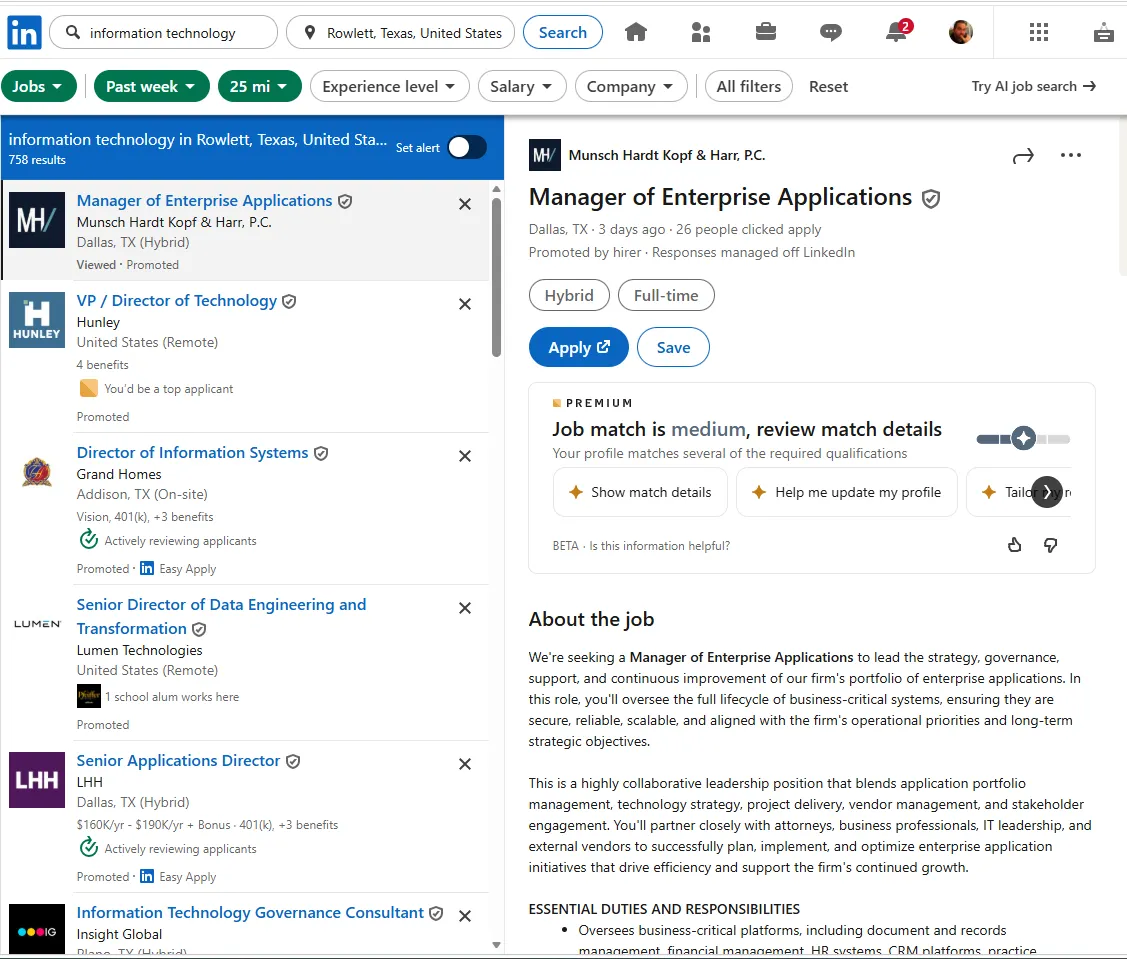
There is only one job in the top 20 that isn’t some kind of sales or management and that is an analyst. Spoiler Alert: Analysts don’t really DO anything any more than managers do, they just document what the smart people are doing.
The point is that there seems to be nobody actually doing the work. There is only management and sales. There are even six figure jobs for “partners” or people who know people. The good old boy network is so deeply ingrained into business that it looks like nobody does anything anymore. We are a nation of bumbling ‘managers’ who provide no value, just ship the work offshore, and worthless salesmen who also suck up valuable resources without providing a tangible (to the consumer) return.
Speaking of the consumer, and we all are consumers, figure out what you need, what features are necessary on anything you buy and go find it. The company with fewer managers and salespeople should have a lower price and that needs to be rewarded.
Something we have brought up before is management consulting firms. In this new “desert of the real,” We are seeing them collapse. AI has brought the realization that the advice they give is always the same, they just paste in the names of the C-Suite denizens and the company name into a pre-prepared document and there is your millions-of-dollars analysis. This IS a job that AI can do, if really the only one. This also points to the formulaic, brain dead way of doing things that managers do: Nothing mostly, but buy Salesforce and ServiceNow and Workday and SAP and just wait for the profit to roll in. None of those things help build a product or service that is worth paying for. The product or service is still being tracked and accounted for with spreadsheets, just like it was by the fictional Bob Cratchit in 1843. The very real business Lloyds of London used spreadsheets to track ships and cargo and the value contained in them in 1689. That ancient Sumerians tracked their agricultural output and profits over 5000 years ago.
Nothing has changed in 5000 years. At least the Sumerians knew how and when to produce crops.
The Logical Conclusion
I think we are already in the “desert of the real.” Few to nobody knows how to do anything, or at best have some point solution on his or her résumé that speaks to a bizdiot. Yes, it is good to have Amazon Web Services (AWS) on your resume. No, AWS is not a worthy solution. It is wholly proprietary, complete with a steep learning curve, and even after you have it down cold, it doesn’t do anything. You still have to write the code that runs on it. It is kind of like having shiny new wheels and no car to put them on. None of this mentions that it is eye-wateringly, crushingly expensive. Nobody at the management level has done the analysis it seems, just follow-the- leader (an upcoming article) because that is what business school or a management consultant said you needed to do.
In this “desert of the real” we are a society of know nothing, do nothing consumers who buy a new one instead of fixing the old one. We sit in air conditioned offices all day making big decisions. We don’t understand the consequences of the decisions we make, but we are big and important and make big decisions we shall. This kind of thinking will cause the collapse of this society.
We are in a time of religiously worshipping the wrong people. When I was a kid, we thought the astronauts and scientists were worthy role models. We did things and figured out things because we had to. Now it is all pop culture, influencers and actors/”musicians”/wealthy bizdiots. We moved from a culture of respecting and emulating people who DO things to people who SELL things. Do you think Elon Musk designed and built the Tesla? Do you think he designed and built the Falcon Heavy? HE SOLD the idea of a battery car and a new rocket to investors and then used their money to ask the smart people to make a product. In reality he has done nothing but lose money and line his own pockets. He promised better battery technology that never came to fruition and self-driving cars that are literally impossible with today's technology and probably just aren’t possible until we figure out how real intelligence works, and another spooner alert: AI ain't it. In fact, AI doesn’t mean "Artificial Intelligence,” it means “Ain’t It.”
The Short Answer
Quit hopping on the bandwagon. If you can invest in some of this new technology it is too late for you to make any money at it.
All you have to do to thwart the bizdiots is refuse to participate. Don’t buy from or invest in these management and sales heavy companies.
The Slightly Longer Answer
Here is a list of infamous bubbles that went bust and left investors broke and in some cases crashed the world economy:
Tulipmania (1630s, Netherlands): Tulips became a luxury status symbol, and prices for rare bulbs skyrocketed, sometimes equaling the cost of a house. The market collapsed in 1637, leaving many investors financially ruined and causing a minor economic depression in the Netherlands.
South Sea Bubble (1720, Britain): The South Sea Company promised immense profits from trade in South America. Stock prices surged from £128 to around £1,000 in months, fueled by speculation and bribery. The crash wiped out thousands of investors and led to government investigations and arrests.
Mississippi Bubble (1719–1720, France): John Law’s Mississippi Company issued shares backed by French colonial trade. Speculation drove prices to unsustainable levels, and the collapse caused widespread financial ruin and economic instability
Roaring Twenties Stock Market Bubble (1924–1929, USA): Rapid stock market growth, fueled by easy credit and speculative investment, culminated in the 1929 crash, triggering the Great Depression.
Japanese Asset Bubble (1980s, Japan): Real estate and stock prices soared due to excessive credit and speculation. The bubble burst in the early 1990s, leading to a prolonged economic stagnation known as the “Lost Decade”.
Dot-Com Bubble (late 1990s–2000, USA): Internet-based companies saw their stock prices surge despite limited profits. The bubble burst in 2000, causing massive losses for investors and a temporary market downturn.
US Housing Bubble (2000s, USA): Easy mortgage credit and speculative investment in real estate drove housing prices to unsustainable levels. The 2007–2008 collapse triggered the global financial crisis.
Cryptocurrency Bubble (2017–2018, global): Bitcoin and other cryptocurrencies experienced rapid price increases, followed by sharp declines, highlighting the volatility of speculative digital assets.
To this list I personally will add AI. Even if AI were the thing bizdiots claim it to be, and it isn’t, then it still doesn’t live up to their hype. If we stopped investing right now and just let the process run its course, we would have a major depression on par with those previously listed. If we continue to invest more and more in these bizdiot financial schemes built on clouds and suppositions, the 2008 collapse will look like a child playing with Legos. Again, just like we discussed with Elon and his upcoming battery revolution that never happened, AI is a parlor trick based on what token, or part of a word, is statistically most likely to occur in a sentence. That is it. There is no wisdom, there is no problem solving and anything that AI has claimed to do like solving a math problem that has existed for about a hundred years, is really just ten billion monkeys typing on ten billion typewriters for ten billion years. Sure eventually one will type the collected works of Shakespeare, but at what cost?
The real answer is to teach your children to think about what they are being handed. Show them how to follow the money and see through the hype. Show your children and probably yourself, how things work, what goes into designing and building them and how to fix them when they break. I cut my teeth on cars in the 70s and then, if you didn’t know how to build or fix your own car, you didn’t drive. No, Virginia, it is easier now to work on your own car, or anything else, not harder. We had to rely on the old guy down the street that knew things, sometimes incorrect things, to teach us how to get where we wanted to go. Today you have the University of YouTube. Even then, you have to look at the videos with a jaundiced eye and follow the money to validate the veracity of the video presented.
If you are a manager, simply don’t be a bizdiot. Sure PWC or Deloitte told you to install all these applications and move your operations into the cloud. Did you actually do the math to see what those things will cost you versus on prem and to build the one application to do everything your business does, yourself? The big consulting firms found they can’t write software, and they can’t for the reasons we listed above. They don’t know what goes into that. They are so clueless about how to build software that they can’t even hire people to do it for them. So don’t be a bizdiot and just follow the advice of some high priced consultant simply because he is high priced. The due diligence is yours alone. Think about the purchase price of the apps they sell, think about the consulting fees, think about the infrastructure you have to have and the people to run it. Think about the developers and architects you have to hire to finish these half baked solutions. Finally, think about the data in all the little silos that are doing you no good until you can pay to have it all integrated. You will have none of the big data insights they promise until you integrate everything and even then, you have to pay for the big data solution. What does all that cost compared to doing it all yourself?
I am not telling you that the app/infra/staff/integration treadmill is the wrong way. What i am telling you is that you don’t either, until you do the calculations to see for yourself.
Conclusions
The real lesson here is due diligence. If you have managers they have to be able to at least understand the work of the people they manage. If you have a viable product or service, you don’t need sales people. You might need marketing, but if you have real advantages over your competition, even if it is price, you do not need to hire ex high school football players and cheerleaders to pitch to and convince people to part with their money.
“Do the due,” be thoughtful and follow the money to see who profits and why. If a company is after an IPO, then it is probably not something you want to invest in.
We have shown you a better way to run the railroad that is your business. You don't need managers and you don’t need salespeople. The people you have working for you now know how to do what they do. Managers are an attempt to get them to do something different. Consequently your product or service sucks and is over priced. Salespeople are the natural outgrowth of having a bad, overpriced product. You have to convince people to buy it.
Once again, you are doing it wrong. All your management frameworks, all your cajoling and wheedling and moaning and crying to get your employees to do what you want instead of what they want to do are no substitute for the due diligence of knowing the best way to solve any problem. Again, “do the due.” Only then will your company or organization be aligned with reality and poised for success. If you can’t do what your reports do, don’t tell them how to get it done. Really, that means that the only effective manager is the one that can jump in and do the work if necessary, and all your business school and MBAs are worthless.
If this makes you angry, good, Change your ways until you don’t see yourself here anymore.
Sales is the compensatory response to having a bad product or service. You may need marketing to get the world out, but paying someone to convince a single person to do what you want them to do instead of what they want to do is an exercise in futility and slightly ethically ambiguous and there is built in conflict of interest with any salesperson.
They don’t get paid until they sell something. I suppose that the weak minded knows little enough about what they are buying to be convinced, but are those really the clients you want?
Remember, this is part four of a fifteen-part series about how businesses are being run incorrectly by unthinking, lemming bizdiots. We are demonstrating not only the problems of modern business, but real, viable solutions.
I will be putting out one or maybe two articles per week. If you liked what you read contact us here, on our site, SentiaHealth.com, our parent company SentiaSystems.com, or send us an email to info@sentiasystems.com or info@sentiahealth.com.
Comment
| Date Written | Comment |
|---|